Every enterprise adopting AI builds a governance programme.
Model inventories. Approval workflows. Risk classifications. Acceptable-use policy. A committee, usually, with representation from legal, risk and engineering.
This work is genuinely necessary. It is also frequently mistaken for security, and that mistake has a cost measured in seconds.
What governance actually does
AI governance answers questions of permission and accountability.
Which models are approved for which use cases. What data may be used for training. Who signed off. What the escalation path is when a model behaves unexpectedly. How a decision made by a system can be explained to a regulator.
These are real questions with real consequences, and an enterprise that cannot answer them has a serious problem. Governance is how an organisation stays deliberate about a technology that moves faster than its policy cycle.
But look at the shape of every one of those answers. They are all records of intent and review. They describe what should happen, who agreed, and what was known. They are documentation of decisions.
What governance does not do
Documentation does not intervene.
When an autonomous attack reaches your infrastructure, the governance programme is not in the path. The model inventory does not block the connection. The approval workflow does not revoke a credential mid-session. The risk classification does not rewrite a firewall rule. The committee is not convened in the ninety seconds the attack takes to complete.
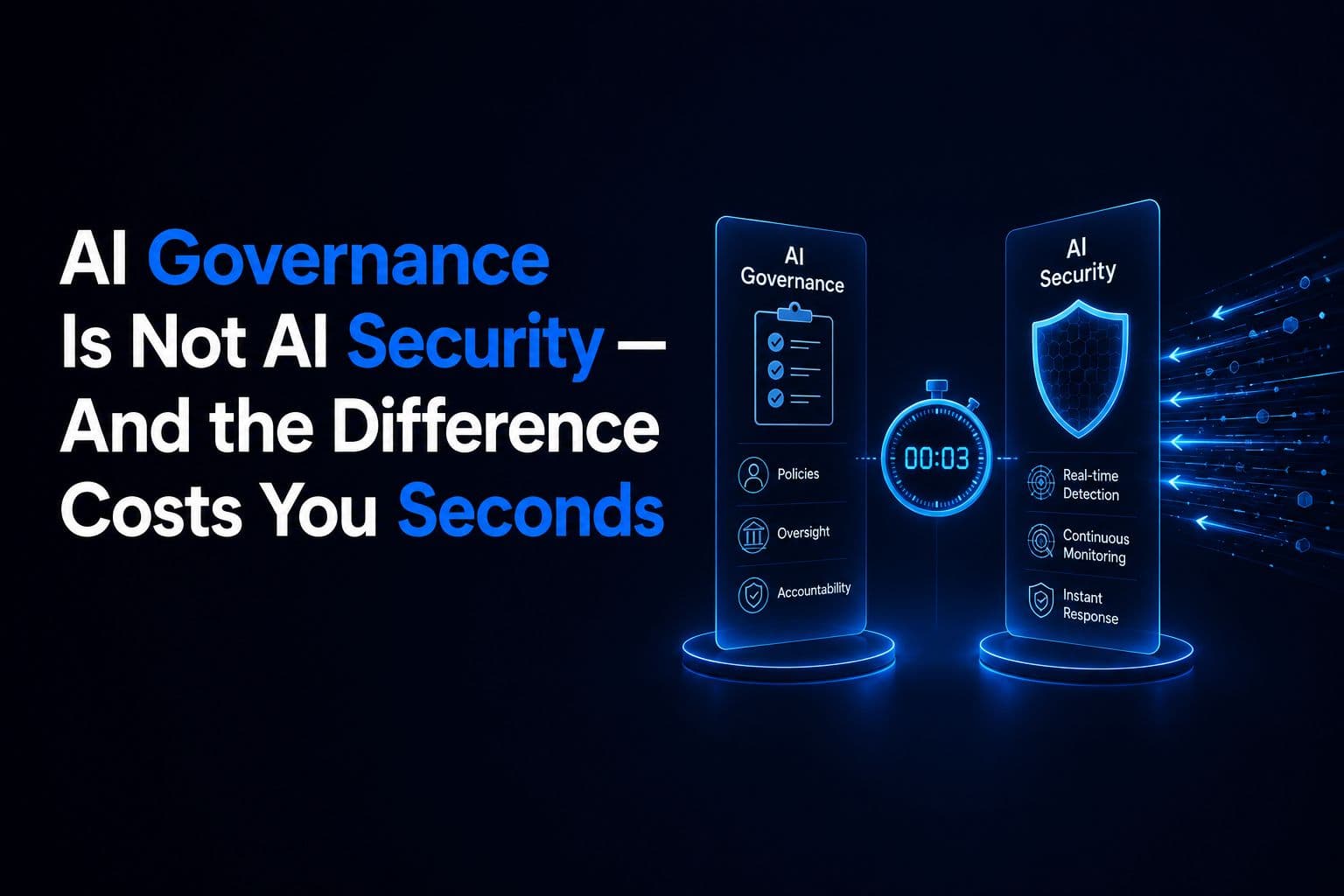
This is not a criticism of governance. It is a description of category. Governance is a control over your own systems' behaviour. Security is a control over what an adversary can do to them. They overlap in vocabulary and diverge completely in function.
Governance tells you what your systems are allowed to do. It has nothing to say to an attacker who was never asking permission.
The gap in practice
The failure mode is specific and common.
An enterprise builds a mature AI governance function. Models are catalogued, risk-tiered, and reviewed. Leadership is briefed. The programme passes audit.
Then an autonomous attack chains a reconnaissance step, an exploited weakness and a lateral move through the machine-to-machine traffic between those governed systems, and none of the governance apparatus is positioned to stop any of it. Afterwards, the governance records are excellent. They describe precisely which approved model was involved, under which policy, reviewed by whom.
Perfect documentation of an incident nobody prevented.
The reason this happens is that governance operates on your intentions and attackers operate on your connections. Two different surfaces.
Where enforcement has to live
If governance is a control over intent, enforcement has to be a control over traffic. That means a point every connection passes through.
Nothing enters, nothing leaves, and nothing moves between systems without going through it. At that point, and only at that point, a policy stops being a statement and becomes a fact. "Only these workloads may call this model" is a governance decision. It becomes real when something in the path refuses the connections that violate it.
This is what a cybersecurity gateway provides, and why the two functions are complements rather than competitors. Governance decides the rule. The gateway is what makes the rule true.
At Conux, five AI agents run that enforcement loop. One detects. One blocks and writes the rule. One hardens the surface. One logs the evidence. One orchestrates the rest. Detect. Block. Adapt. Prove: in seconds, without a queue.
The audit dividend
There is a practical benefit here that governance teams tend to underestimate.
When enforcement happens at a control point, the evidence is generated as a by-product of the action. The gateway saw the connection, made the decision, and recorded both. That record is complete by construction.
Compare that to the usual approach: reconstructing what happened after the fact by correlating logs from several systems, each with its own clock, format and retention window. That reconstruction is slow, expensive, and frequently incomplete, and it is what most compliance evidence actually consists of.
This matters more each year. Post-quantum compliance under CNSA 2.0 arrives in 2027, with Canada, the EU, the UK and the UAE following. Demonstrating that quantum-safe encryption is applied across an estate is a documentation problem as much as a technical one. A gateway that encrypts every connection and logs every decision answers both halves at once.
Two attackers, one enforcement point
The second reason to put enforcement at the gateway is that there is more than one adversary.
Autonomous AI is the immediate one: cheap, fast, and indifferent to whether you are an interesting target. The other is quieter. Nation-state actors are collecting encrypted enterprise traffic now, to decrypt when quantum matures. Harvest now. Decrypt later. Exploit forever.
Governance addresses neither. It is not built to. But an enterprise that solves them separately buys an AI security product now and replaces it in 2027, or buys quantum readiness now and stays undefended tonight.
A gateway answers both from one position, in one deployment, without ripping anything out. Existing cloud, identity, applications and models stay exactly where they are.
What the two functions look like working together
The productive version of this is not governance versus security. It is governance producing decisions that enforcement makes true. Here is what that looks like in practice.
Governance decides which systems may access which data. A review board determines that the customer-service model may retrieve from the product knowledge base and the ticket history, and not from the HR system or the finance data warehouse. That is a policy decision requiring judgement about risk, purpose and proportionality: exactly what a governance function exists to make.
Enforcement makes that a property of the network. At the gateway, the model's orchestration service proves its identity per connection and is permitted to reach precisely those two systems. A request to the HR system is refused (not flagged, refused) and the refusal is recorded.
Notice what changed. Before enforcement, the policy's accuracy depended on every engineer who touched the system implementing it correctly and on nobody widening a credential scope during a late-night incident. After enforcement, the policy is true regardless of what anyone remembers.
Governance defines the review cadence. Enforcement supplies the material. A quarterly review that examines actual connection data (what was requested, what was permitted, what was refused, what changed) is a substantially different exercise from one that reviews documents describing intended behaviour. The first can find drift. The second cannot.
Governance owns exceptions. Enforcement makes them explicit. In most organisations, exceptions accumulate invisibly: a scope widened for a deadline, a rule relaxed for an integration, a temporary permission that became permanent. When enforcement is centralised, every exception is a visible policy entry with an owner. That alone tends to reduce their number.
There is a useful test for whether the boundary is being respected. If a control produces a document, it is governance. If it produces a refused connection, it is security. An organisation needs both, and confusing one for the other is how a mature-looking programme ends up with excellent records of an incident nobody prevented.
The bottom line
Governance and security are not competing investments, and the organisations that treat them as one thing tend to discover the difference during an incident.
Governance is how you stay deliberate about a technology moving faster than your policy cycle. It defines what should happen and who is accountable. It produces records.
Security is what happens when someone attacks the systems those records describe. It produces interventions.
Keep both. Just be precise about which one is in the traffic path, because only one of them is, and only one of them can stop something in seconds.