Enterprise security has had a genuinely good few years. An AI powered cybersecurity platform now detects threats in real time, correlates signals no human team could track, and responds at machine speed. For the first time, defense feels like it's keeping pace.
Which makes the blind spot easy to miss. The most sophisticated AI powered cybersecurity platform in the world still rests on cryptography built for a pre-quantum world, and no amount of detection intelligence fixes a foundation that's on a countdown.
"The smartest AI defense in the world is still sitting on cryptography it was never built to watch, and can't protect."
What an AI Powered Cybersecurity Platform Gets Right
Modern platforms have changed the economics of defense. They watch everything, learn what normal looks like, and flag the anomaly in the moment rather than the post-mortem. They've compressed response times from days to seconds and given lean teams reach they never had.
This is real progress, and it's worth the investment. But every capability of an AI powered cybersecurity platform operates on top of encrypted data, and the security of that encryption is assumed, not monitored.
The Layer the AI Can't See
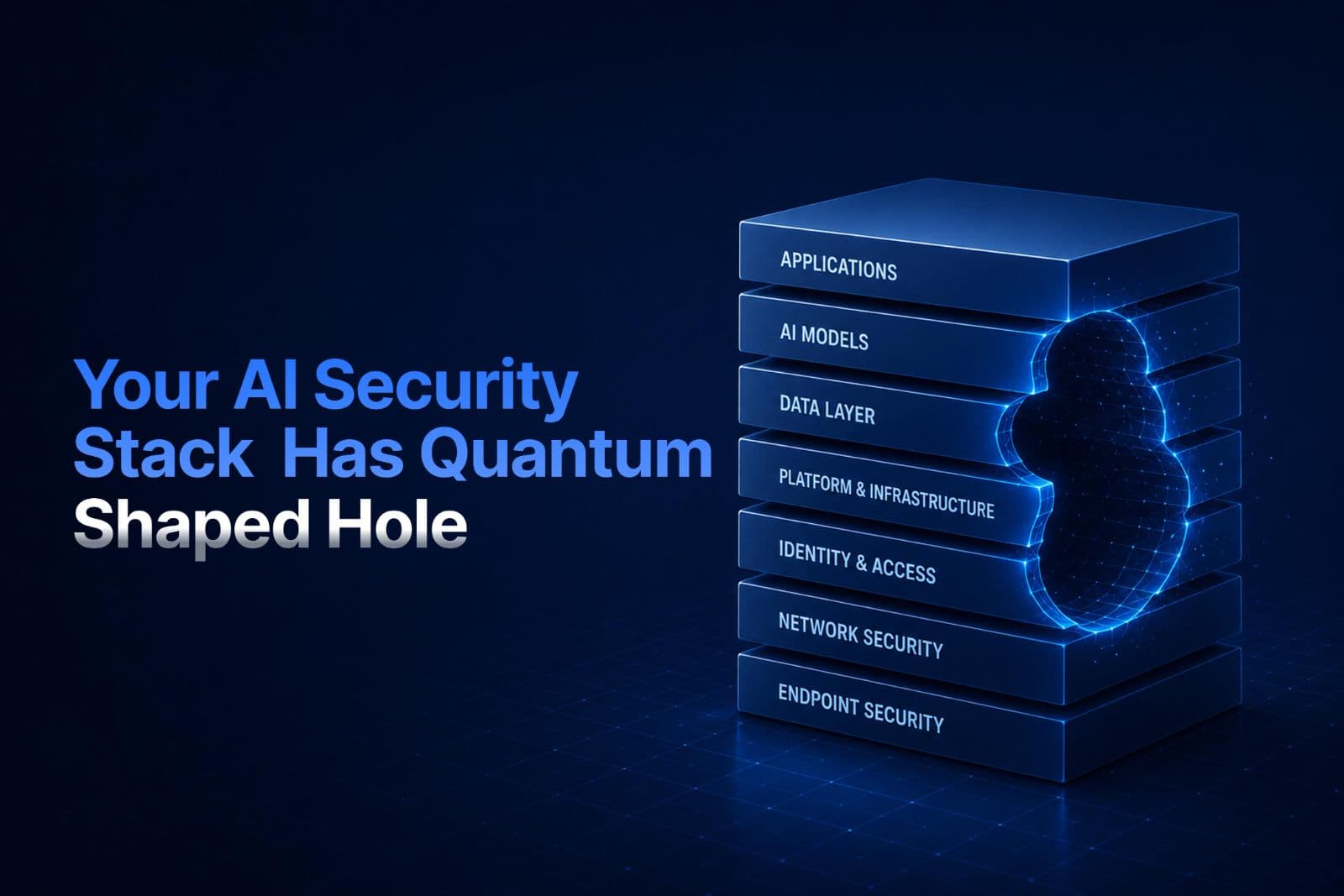
An AI powered cybersecurity platform is brilliant at detecting intrusion and misuse. It is not designed to tell you that the asymmetric cryptography protecting your data is approaching obsolescence. That's not a detection problem. It's a foundation problem, and it sits beneath the layer the AI is watching.
So you can have a flawless real-time defense sitting directly on top of an exposure it was never built to notice. The smarter the stack gets at the top, the easier it is to assume the bottom is handled. NIST finalized post-quantum standards in 2024 precisely because that bottom layer is changing.
Why These Are One Problem, Not Two
It's natural to file "AI security" and "quantum readiness" as separate initiatives with separate owners. They aren't separate. Your AI systems are among the largest, fastest-moving flows of sensitive data you have, and they're protected by exactly the cryptography quantum threatens.
Treating them as one problem is the unlock: the quantum exposure is most acute precisely where your AI investment is most concentrated. With CNSA 2.0 milestones in 2027 and an estimated 97% of enterprises unprepared, the convergence is a timeline, not a theory.
What a Complete Picture Looks Like
A complete posture pairs the detection power of an AI powered cybersecurity platform at the top with quantum-safe, crypto-agile foundations underneath, with visibility into both. Detection tells you when something is wrong now. Cryptographic readiness tells you whether the data being defended will still be safe later.
An enterprise needs both answers. Most have invested heavily in the first and assumed the second.
The Question to Ask Your Security Vendor
If you run an AI powered cybersecurity platform today, the useful question for your vendor isn't about more detection. It's about the foundation. Ask explicitly: does the platform account for the cryptography securing the data it analyzes, and what is its position on post-quantum readiness?
Most will not have a strong answer, because detection and cryptographic foundations are genuinely different disciplines. That's not a failure of the product. It's a signal that the two layers need to be owned together rather than assumed to overlap. The enterprises that close this gap stop treating their AI powered cybersecurity platform as the whole security story and start treating it as the visible half of a two-layer problem.
Pairing that platform with a quantum-safe, crypto-agile foundation and unifying visibility across both is what turns an impressive dashboard into genuine resilience against a threat that detection alone cannot see.
Treat the Two Layers as One Decision
The takeaway for leadership is not to spend less on detection. It is to stop treating detection and cryptographic readiness as separate budgets with separate owners. They protect the same data, on the same timeline, against threats that increasingly overlap. Owning them together is what turns two partial defenses into one coherent posture, and it is the move that closes the quantum-shaped hole for good.