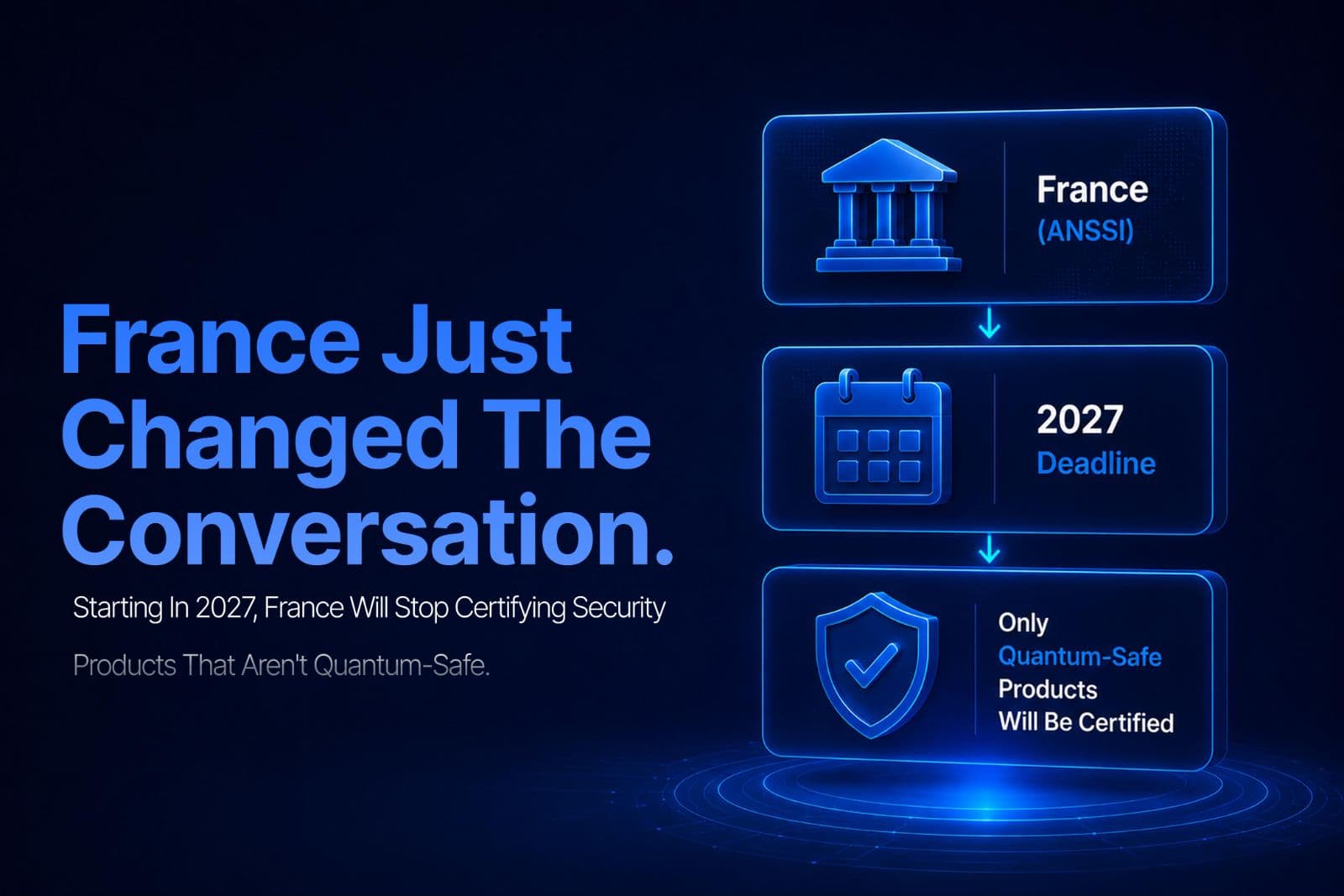
In a boardroom in Paris this month, a government official said something most enterprise leaders haven't heard from a regulator yet: a specific year by which "we'll get to it eventually" stops being an option. At the France Quantum conference, ANSSI, France's national cybersecurity agency, announced that starting in 2027, it will no longer certify security products that lack quantum-resistant encryption. By 2030, ANSSI says businesses should be buying quantum-safe products exclusively.
This is not a white paper or a five-year vision statement. It is a certification gate tied to a calendar, and it places France among the most aggressive governments in the world on quantum-resistant encryption. For any CTO or CISO whose organization sells into, partners with, or operates alongside French government and critical infrastructure, the clock just moved from abstract to enforceable.
Key Takeaways
- ANSSI's certification cutoff is 2027, not a recommendation, a requirement. Security products seeking ANSSI certification after that date must incorporate quantum-safe cryptography, and ANSSI's Chief of Staff Samih Souissi says enterprises should be buying quantum-resistant products exclusively by 2030.
- The "harvest now, decrypt later" threat is the stated reason. Adversaries are intercepting and storing encrypted data today, betting they can decrypt it once quantum computers mature, the same logic driving urgency across the industry.
- Widely deployed standards like ECDSA are flagged as early casualties. Experts at the conference warned that some of today's most common cryptographic algorithms could be among the first broken by future quantum attacks.
- The market is already pricing this in. Capgemini's chief innovation officer told Reuters that institutional demand for quantum-safe solutions is "becoming big" and "going to be very substantial."
- This sits inside a 3-billion-euro national strategy. France's quantum investment is explicitly framed around sovereignty and industrial competitiveness, not just cybersecurity hygiene.
Why a Certification Deadline Changes the Conversation
Most quantum-readiness guidance to date has been advisory. NIST publishes standards, consultancies publish roadmaps, vendors publish whitepapers. ANSSI's announcement is different in kind: it is a procurement gate. Any security product that cannot demonstrate quantum-resistant encryption will simply fail to clear certification for deployment in French government agencies and critical infrastructure after 2027.
Souissi was explicit about why this is bigger than a technical checkbox: "It's not only a technical issue. It's a matter of governance, industrial planning, regulation, and sovereignty." That framing matters. It tells vendors and enterprises that this is being treated the way export controls or data-residency law is treated, as a condition of doing business, not a best practice.
The same dynamic enterprises are watching with AI procurement, where vendors increasingly need to prove their AI systems run on auditable, compliant infrastructure, is now appearing in cryptography. The systems your organization already trusts to move money, store patient records, and run AI workloads are built on encryption that this French policy explicitly says won't pass inspection in eighteen months.
"Harvest Now, Decrypt Later" Is the Reason for the Rush
The cryptographically relevant quantum computer that breaks RSA or ECC at scale does not exist yet. ANSSI's urgency comes from a different threat model entirely: harvest now, decrypt later (HNDL). Adversaries, particularly well-resourced nation-states, are capturing and archiving encrypted traffic today, on the bet that a future quantum computer will make it readable.
"It's not only a technical issue. It's a matter of governance, industrial planning, regulation, and sovereignty." - Samih Souissi, ANSSI Chief of Staff
This reframes when the exposure actually occurs. The breach isn't a future event waiting to happen. For any data with a long confidentiality life, the exposure window opened the moment it was transmitted under a cryptographic standard quantum computing will eventually defeat. Conference participants singled out ECDSA, one of the most widely deployed signature algorithms today, as a likely early casualty, which means the question for most enterprises isn't whether their current stack is exposed, it's how much of it.
The Standards Exist. The Coordination Problem Doesn't Go Away.
NIST finalized its first post-quantum cryptography standards in August 2024: ML-KEM (FIPS 203) for key encapsulation, ML-DSA (FIPS 204) for digital signatures, and SLH-DSA (FIPS 205) for stateless signatures. These aren't drafts. They're the algorithms ANSSI and every other serious regulator now expect enterprises to migrate toward.
But having the algorithms is not the same as having a migration. France's 2027 certification cutoff sits alongside the U.S. CNSA 2.0 mandate (also January 2027 for national-security-connected systems) and the UK NCSC's 2035 full-migration target, a global convergence of deadlines that all assume the same uncomfortable arithmetic: a full cryptographic overhaul typically takes a large enterprise five to ten years. Measured against a 2027 certification gate, the planning has to start in this budget cycle, not a future one.
This is also where most organizations stumble, treating quantum-safe migration as a one-time algorithm swap rather than building crypto-agility: the ability to rotate cryptographic algorithms across every connected system as standards evolve, without re-engineering infrastructure each time a regulator updates the rulebook. A point fix that hard-codes today's ANSSI-approved algorithm into hundreds of systems has just built its next compliance crisis.
The Market Is Already Repricing Around This
Pascal Brier, Capgemini's chief innovation officer, told Reuters that interest from banks and public-sector institutions evaluating their quantum exposure is accelerating: "That market is becoming big. It's going to be very substantial." That's not a vendor talking up a product category. It's a signal that procurement and risk teams across regulated industries are already asking the questions ANSSI's policy assumes they should be asking.
This lands inside France's broader quantum strategy: a national investment plan valued at roughly 3 billion euros (about $3.5 billion USD), positioned explicitly as a competitive response to quantum investment from China, the United States, and other nations. Quantum-safe certification isn't a side effect of that strategy. It's one of its enforcement mechanisms.
What This Means If You Sell Into or Operate Alongside French Infrastructure
- Treat 2027 as a hard certification gate, not a planning horizon. If ANSSI certification matters to your go-to-market in France, your product needs demonstrable quantum-resistant encryption well before the deadline. Certification review takes time.
- Inventory the algorithms flagged as exposed first. ECDSA and similarly structured signature schemes were explicitly called out. Know where they sit in your stack before a regulator or customer asks.
- Build for algorithm swapping, not a single migration. Standards will keep evolving after 2027; an architecture that lets you rotate algorithms centrally avoids repeating this exercise every time a regulator updates requirements.
- Expect this to spread beyond France. CNSA 2.0, NCSC guidance, and now ANSSI certification all point the same direction. Quantum-safe readiness is converging into a baseline requirement across Western regulators, not a France-specific compliance quirk.
Conclusion: The Deadline Is the Signal
What makes ANSSI's announcement different from the usual stream of quantum-readiness warnings is specificity: a named year, a named certification consequence, and a named official stating plainly that this is now a matter of sovereignty, not just security hygiene. The algorithms enterprises need already exist. NIST finalized them in 2024. What France has now done is remove the ambiguity about when "later" runs out.
Organizations that start building crypto-agile, quantum-resistant infrastructure now will meet a 2027 certification gate as a formality. Organizations that wait will be racing a regulator's clock with an architecture that wasn't designed to move that fast.
Source: Reuters, as reported at the France Quantum conference, June 2026, comments from ANSSI Chief of Staff Samih Souissi and Capgemini Chief Innovation Officer Pascal Brier. Original reporting: Matt Swayne, "France Says It Will Won't Certify Security Products That Aren't Quantum-Resistent Starting in 2027", The Quantum Insider, June 18, 2026.