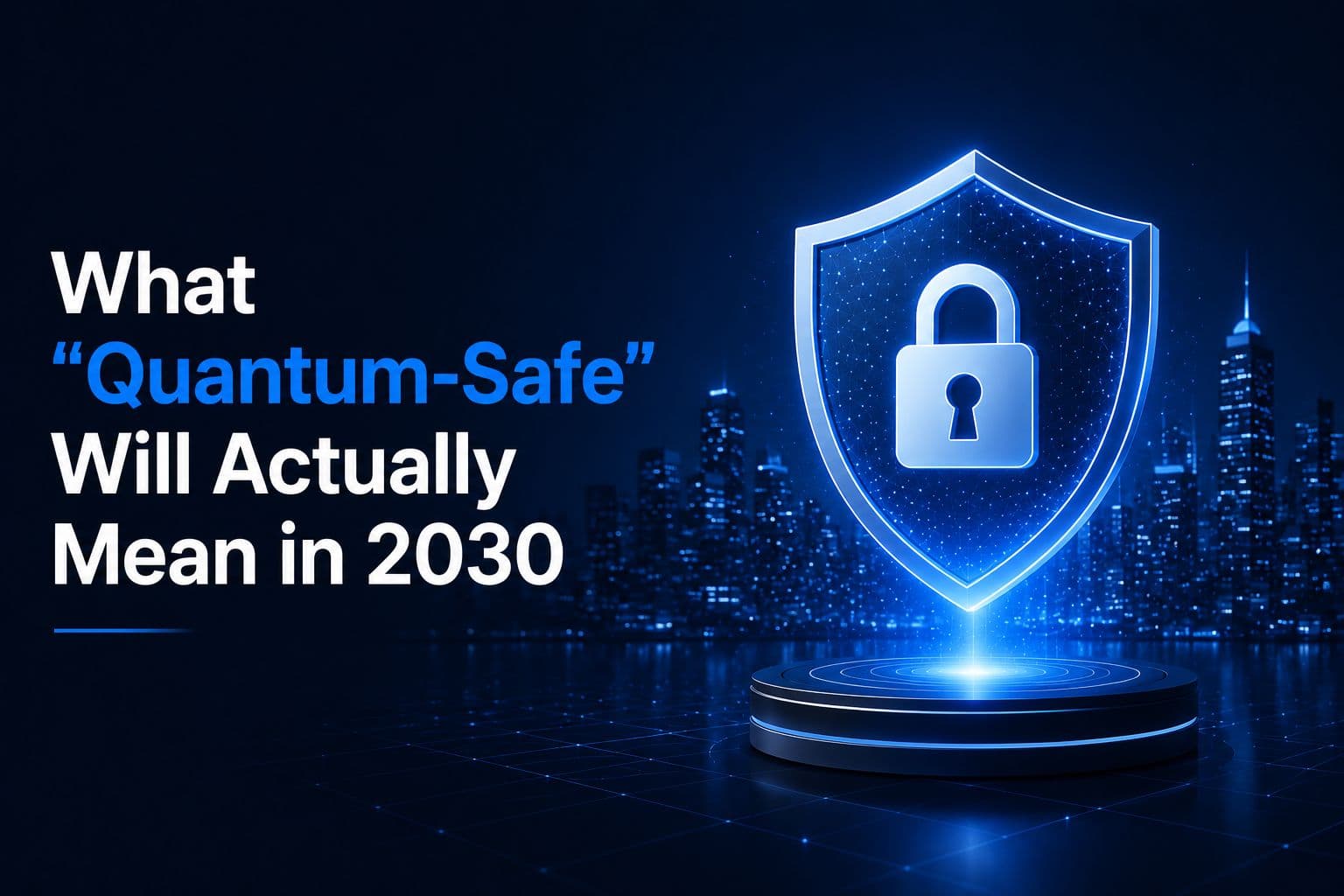
"Quantum-safe" is today's aspiration. By 2030 it will be a baseline expectation, and the definition will have moved well beyond swapping a few algorithms.
Right now, 'quantum-safe' is a goal organizations are working toward, often understood narrowly as adopting new post-quantum algorithms. That definition is already too small. By 2030, when the quantum transition is well underway and the first standards have aged, quantum-safe will mean something richer and more demanding.
Looking ahead helps leaders avoid building for yesterday's definition. The organizations that ask what quantum-safe will mean in 2030, not just what it means today, will build foundations that are still standing when the others are scrambling to catch up. This is risk content with a forward lens.
Beyond Algorithm Swaps
By 2030, quantum-safe will mean an adaptable cryptographic posture, not a one-time adoption of specific algorithms.
The early framing of quantum-safe as 'replace RSA with a post-quantum algorithm' will look quaint. Standards will have iterated, some first-generation choices will have weakened, and the ability to change again will matter more than any single algorithm.
Quantum-safe in 2030 is a property of how adaptable your cryptography is, not which algorithm you happened to pick in the mid-2020s.
Continuous, Not One-Time
Quantum-safe will be a state you maintain continuously, the way you maintain patching or compliance, not a milestone you reach once.
Organizations that treated quantum-safe as a finish line will discover the line keeps moving. By 2030 the expectation will be continuous cryptographic management: ongoing inventory, monitoring, and the readiness to respond to new breaks.
Being quantum-safe will look less like a certificate on the wall and more like an operational discipline that never stops.
Provable, Not Asserted
By 2030, claiming to be quantum-safe will not be enough. Regulators, partners, and customers will expect proof.
As the transition matures, assertions will give way to evidence. Expect requirements to demonstrate cryptographic inventory, transition status, and agility to partners conducting due diligence and regulators enforcing mandates. Quantum-safe becomes something you prove, not something you say.
Organizations without the evidence will find themselves excluded from deals and out of compliance, regardless of their actual posture.
Extending to Machine Identity
By 2030, quantum-safe will not stop at data in transit. It will extend to the identities of the machines and agents running the business.
As AI agents proliferate, quantum-safe will have to cover the cryptographic identities those agents depend on, not just network traffic and stored data. A definition that ignores machine identity will be incomplete in exactly the area growing fastest.
The convergence of AI and quantum means the 2030 definition of quantum-safe is also a definition of trustworthy autonomy.
Building for the 2030 Definition Now
The cheapest time to build for what quantum-safe will mean in 2030 is while you are doing the transition anyway.
Organizations modernizing cryptography today can build for the richer 2030 definition (adaptable, continuous, provable, and inclusive of machine identity) at little extra cost. Building only for the narrow 2025 definition guarantees a second effort later.
Conux builds for the 2030 definition from the start, so quantum-safe is a durable posture rather than a milestone that quietly expires.
Quantum-safe in 2030 means far more than algorithm swaps. Conux builds for that definition now: start the conversation.