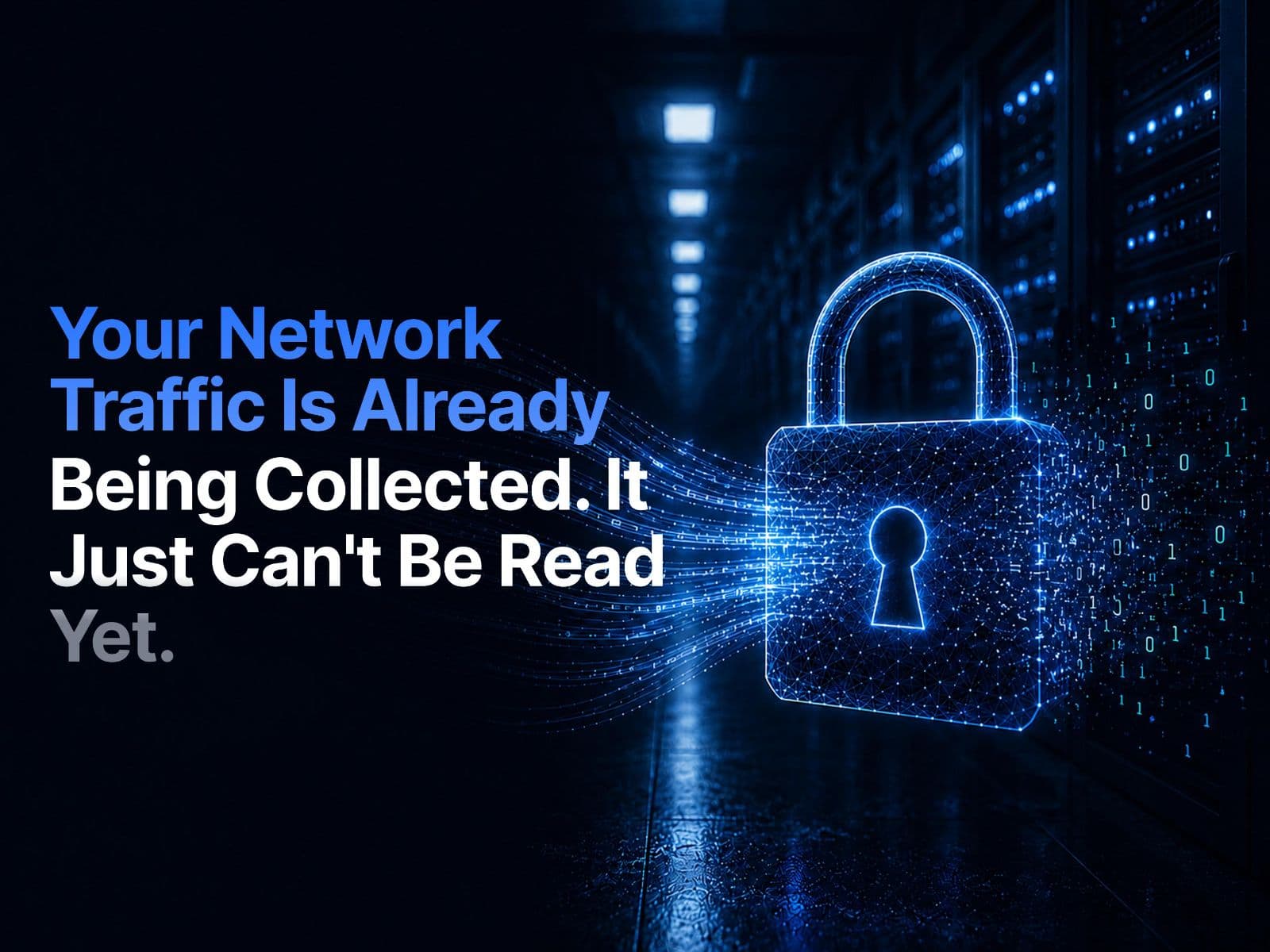
Picture a warehouse somewhere. Climate-controlled. Well-organized. Filling up steadily, day after day, with compressed archives of encrypted data.
Your network traffic is in there. The VPN sessions your remote teams open every morning. The API calls your payment systems exchange with your bank. The communications between your executives and your legal team. The data your healthcare systems transmit between facilities. It's all there, neatly stored, patiently waiting.
Not because anyone can read it today. They can't. Your encryption is doing its job. The data is captured but not decrypted. Collected but not comprehended.
The collection doesn't require breaking your security. It just requires access to the network paths your traffic travels. Nation-states have documented, sustained access to backbone internet infrastructure. The collection has been running for years. It will continue.
The calculation is simple: store it now at negligible cost, decrypt it later when quantum computing makes the mathematical problem your encryption relies on trivially solvable. Your security team would call this harvest-now-decrypt-later. Your board should call it a liability that is accumulating in real time.
Quantum safe networking is how you stop adding to that inventory.
The Specific Problem With Your Network Security
Your current network security architecture is, in many ways, excellent. It was designed by smart people, implemented carefully, and keeps out a staggering number of threats every day.
But it was built on an assumption that quantum computing has put in jeopardy: that the mathematical problem protecting your encryption is effectively unsolvable.
Here's the precise issue. When two systems communicate securely over your network (a user connecting to your VPN, your payment system calling your bank, your cloud platform syncing with your data center) they go through a process of agreeing on a shared secret to protect the conversation. That process uses mathematics based on problems that classical computers cannot solve efficiently.
A sufficiently powerful quantum computer can solve those problems. Not faster. Differently. The approach is fundamentally different, and it works.
Your bulk data encryption (the part that actually scrambles the content) survives this. The mathematics behind it is harder to crack. But the handshake that starts every secure conversation, the process that agrees on the keys that protect everything else, that part does not survive.
Which means an adversary with captured traffic and eventual quantum capability can recover those handshake keys and use them to decrypt everything that followed. Every session. Every file. Every communication.
This is not a hypothetical. This is the architectural reality of every network running standard security protocols today, which is essentially all of them.
What's Actually at Highest Risk
Not all network traffic carries equal consequence. The harvest is broad, but the damage is concentrated. Three categories are worth specific attention.
Long-retention business data. Financial records, patient information, legal communications, M&A discussions, intellectual property. Data with a 10-year confidentiality requirement is exactly the kind of data that makes harvest-now-decrypt-later operationally dangerous. Current quantum computing capability timelines suggest a 5-to-15 year window before the most advanced adversaries achieve the necessary capability. If your sensitive data needs to stay secret until 2035, it has a problem right now.
Vendor and partner access channels. Remote access paths (the connections your IT vendors, system integrators, and managed service providers use to administer your infrastructure) are high-privilege and often less scrutinized than primary enterprise connections. They're also documented HNDL targets because they carry authentication credentials and administrative commands, which reveal not just data but the keys to the infrastructure itself.
AI system communications. This is the emerging risk that most organizations haven't fully processed. As AI systems become more embedded in enterprise operations (making decisions, accessing sensitive data, communicating with external services) the data flows they generate become high-value harvest targets. An adversary who can eventually decrypt AI system communications from the next few years gains operational intelligence that goes far beyond individual records.
The Transition From Exposure to Protection
Quantum safe networking is not a rip-and-replace project. The path from where your enterprise is today to a genuinely quantum-safe network posture follows a logical sequence that can be implemented without disrupting operations.
Start at the highest-risk perimeter. Your external connections (everything that crosses the boundary between your enterprise and the public internet) carry the highest HNDL exposure because they're the easiest to collect at scale. Applying hybrid quantum-safe encryption to those boundary connections provides immediate protection on your most exposed traffic without requiring changes inside the network.
Protect the channels that carry the most consequence. Not all internal traffic requires equal treatment. Quantum safe networking applied intelligently prioritizes based on what the data is, who's accessing it, and how long it needs to stay private. Executive communications get different treatment than routine internal traffic. Patient data gets different treatment than employee calendars.
Make it infrastructure-level, not application-level. The most operationally achievable approach is protection applied at the infrastructure layer (between your enterprise and the outside world) rather than requiring every application to be individually updated. This covers your entire network estate, including legacy systems that were never designed to be updated for cryptographic changes.
Build for agility, not just for today. The quantum computing threat is real, but the standards world around it will continue to evolve. Quantum safe networking built on crypto-agile infrastructure (designed to swap algorithms as standards develop) means you're not solving this problem once and hoping the problem stays the same.
The Decision That Determines Your Exposure Window
Every day that passes without quantum safe networking in place is a day of additional traffic being added to that warehouse. The exposure window doesn't close on its own. It closes when you close it.
The organizations that implement quantum safe networking now are not panicking. They're making a calculated decision: the cost of implementation today is lower than the cost of exposure tomorrow. The liability is accumulating. The technology to stop the accumulation exists. The decision is a leadership one.
CONUX AI applies quantum safe networking at the infrastructure orchestration level, across AI systems, enterprise applications, payment connections, cloud integrations, and remote workforce traffic simultaneously. The CONUX SHIELD applies protection without requiring individual application changes, routes data by sensitivity, and generates the compliance documentation that regulators are beginning to ask for.
The warehouse is filling. The question is when you decide to stop sending it inventory.