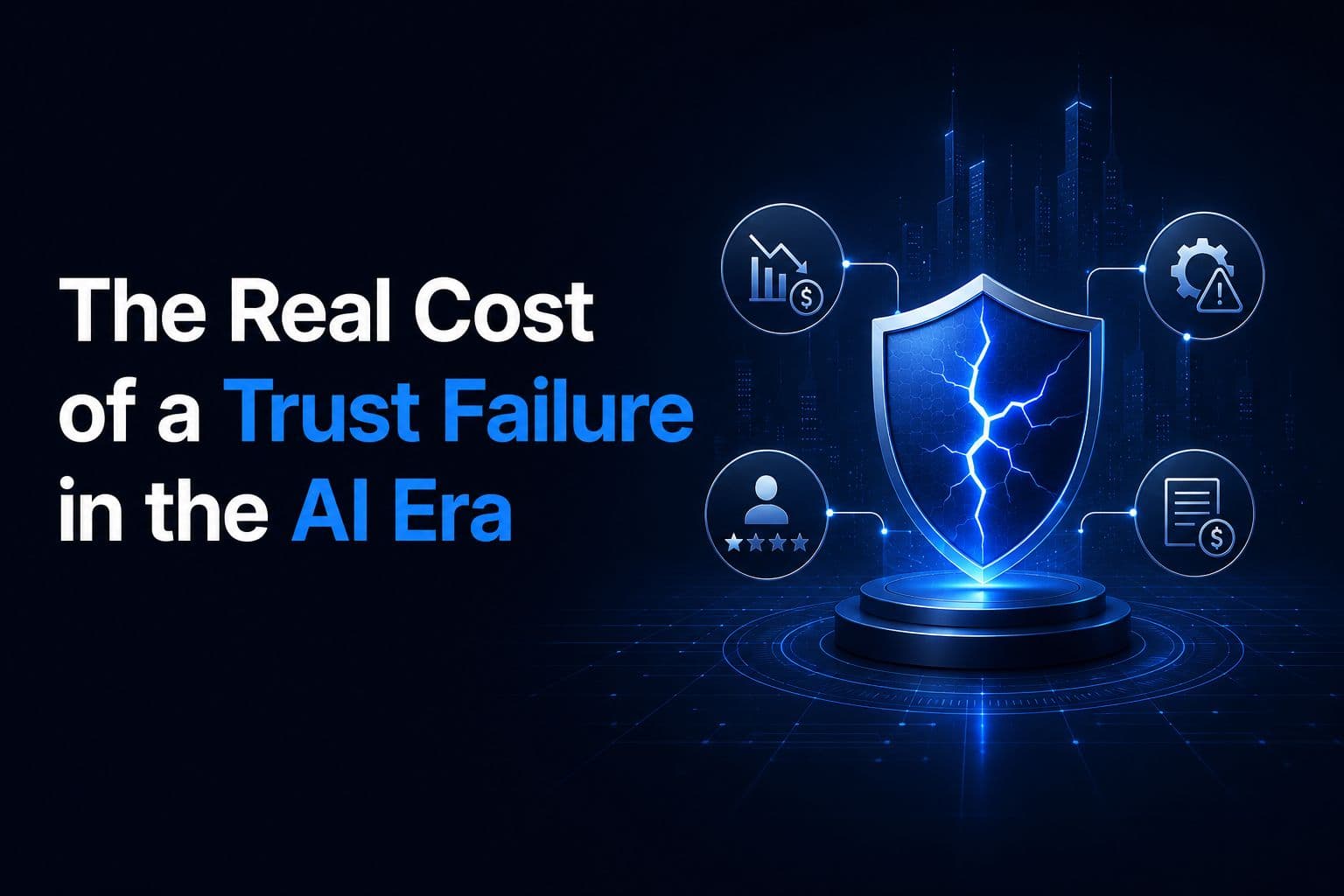
In the human era, a trust failure was a breach to be contained. In the AI era, a trust failure can propagate at machine speed before anyone is even aware it began.
Organizations are used to thinking about the cost of a security incident in familiar terms: data exposed, systems down, fines paid, reputation dented. Those costs are real and well understood. But the AI era changes the shape of a trust failure in ways that make the old cost models dangerously incomplete.
When machines act autonomously on trust, a failure in that trust does not wait for human reaction time. A compromised or forged identity can be used by agents making decisions and transactions continuously, propagating consequences faster than any team can respond. The real cost of a trust failure in the AI era is not just larger: it is structurally different.
Failures Propagate at Machine Speed
A human-era breach unfolds at human speed, leaving time to detect and contain. An AI-era trust failure can cascade through autonomous systems before detection.
When agents act on trust without human approval, a compromised identity is immediately usable across every action that identity can take. The window between compromise and consequence collapses from days to seconds, and the damage scales with the agent's reach.
Containment strategies designed for human-speed incidents are structurally too slow for failures that propagate autonomously.
The Blast Radius Is the Agent's Authority
In the AI era, the cost of a trust failure is bounded by what the compromised agent was authorized to do, which is often a great deal.
An over-privileged agent whose identity is forged or compromised can act across everything its authority permits: moving funds, changing configurations, accessing data, triggering downstream agents. The blast radius is not one breach but every action the trusted identity could take.
This is why scoped, least-privilege machine identity is not hygiene; it is the difference between a contained incident and an autonomous catastrophe.
Attribution Becomes Costly
Without strong machine identity, the most expensive part of an AI-era trust failure is often figuring out what actually happened.
When agents act without verifiable identity and integrity, reconstructing a failure (which agent did what, under whose authority, with what instructions) becomes slow and uncertain. That uncertainty extends the incident, complicates response, and undermines confidence in every system involved.
Strong identity and tamper-evident integrity turn an unanswerable forensic mess into a clear, attributable record. The absence of them is a hidden but enormous cost.
The Quantum Multiplier
A trust failure caused by broken cryptography is the worst case: every identity built on that cryptography is suspect at once.
Individual compromises are contained problems. A failure of the underlying cryptography is systemic: it does not compromise one identity but calls every identity into question simultaneously. The quantum transition is exactly the kind of event that could trigger this if foundations are not resilient.
Conux builds quantum-resilient trust precisely to prevent the systemic version of trust failure, where the foundation itself gives way.
Why Prevention Is the Only Economics That Works
For AI-era trust failures, the cost of prevention is trivial next to the cost of a failure that propagates autonomously.
When consequences move at machine speed and scale with agent authority, after-the-fact response cannot be the primary strategy. The economics only work if trust is verifiable and resilient before failure, so failures are contained or prevented rather than chased.
Conux delivers that prevention: scoped, verifiable, quantum-resilient machine identity that keeps a trust failure from becoming an autonomous, systemic, and enormously costly event.
In the AI era, trust failures move at machine speed. Conux builds the resilient foundation that prevents them: talk to our team.