Zero trust is the most useful idea enterprise security has produced in twenty years.
Never trust, always verify. Assume breach. Authenticate every request rather than trusting a network location. It replaced a genuinely bad model (the hard shell with a soft interior) with something coherent.
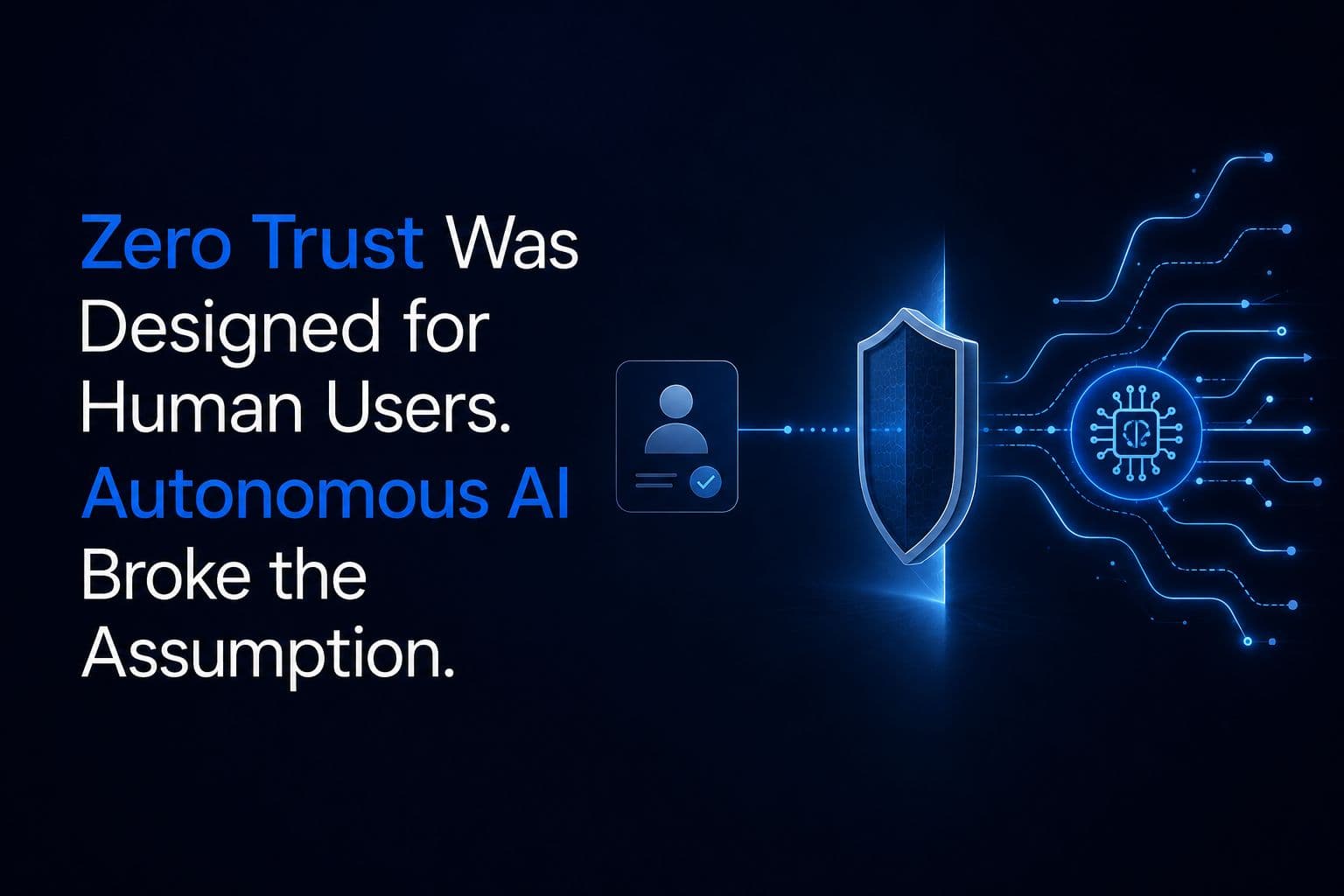
It also rests on two assumptions that autonomous AI has quietly invalidated.
Assumption one: there is a principal to verify
Zero trust asks who is making this request. The architecture around that question was built when the answer was a person, or something acting clearly on a person's behalf.
Identity providers, multi-factor authentication, device posture checks, conditional access, session risk scoring: all of it developed around a human principal with attributes worth checking. Is this the right person, on a known device, from a plausible location, behaving normally?
Most traffic in a modern enterprise now has no person in it at all. Services call services. Workloads call APIs. Models call tools. Agents call other agents. The volume of machine-to-machine traffic exceeds human-originated traffic by a wide margin in any organisation running meaningful automation.
For that traffic, "who is making this request" is usually answered by a shared secret in a configuration file. Not verified per connection. Not tied to a posture. Frequently not rotated. Often over-scoped, because narrowing it precisely was harder than granting broad access.
The verification apparatus is world-class for the minority of traffic and thin for the majority.
Zero trust verifies principals and takes time to do it. Autonomous attacks have no principal worth verifying and do not leave you the time.
Assumption two: verification happens fast enough to matter
The second assumption is temporal, and it is the more serious one.
Zero trust does not promise that nothing bad gets in. It promises that when something does, it is contained: segmented, re-verified at each boundary, limited in lateral movement, and detected as it probes. That containment model assumes the adversary needs multiple attempts across some meaningful stretch of time, which gives detection and response a window to work in.
Autonomous attacks compress that window to nothing. An automated adversary enumerates in parallel rather than probing sequentially. It does not pause between attempts to reconsider. It finishes in seconds.
Enterprise response time is measured in hours. Autonomous attack time is measured in seconds. Segmentation still helps (it always helps) but "detected and contained" only means something if containment executes inside the attack's timeframe. If the containment step routes through a person, it does not.
What survives, and what does not
This is not an argument to abandon zero trust. Most of it is correct and worth keeping.
Survives: the principle of no implicit trust from network position. Least privilege. Segmentation. Continuous verification as a concept.
Does not survive contact with autonomous AI: verification designed around human principals; containment that depends on human-timed response; policy that is documented centrally but enforced inconsistently across each application.
The gap is not conceptual. Zero trust says verify every request. The gap is that most enterprises cannot actually verify most of their requests, and cannot act on a failed verification quickly enough to matter.
Closing both gaps at one point
Both gaps are properties of where enforcement happens.
If verification is implemented per application, coverage depends on every team implementing it correctly, and machine-to-machine paths get the least attention. If response routes through a queue, it operates on human time regardless of how fast detection is.
A cybersecurity gateway addresses both by position. Every connection passes through it: nothing enters, nothing leaves, nothing moves between systems without doing so.
At that point, machine identity is verified per connection rather than assumed from a secret. Policy is enforced rather than published. And the response is executed by agents in seconds rather than raised for someone to action: one detects, one blocks and writes the rule, one hardens the surface, one logs the evidence, one orchestrates the rest. Detect. Block. Adapt. Prove.
That is zero trust's original intent, implemented where it can actually be enforced against an adversary that does not wait.
The attacker zero trust was never scoped for
There is a third gap worth naming, because no amount of verification addresses it.
Nation-state actors are collecting your encrypted traffic today. They are not trying to authenticate. They are not attempting lateral movement. They are copying ciphertext and storing it until quantum computing matures, at which point a decade of intercepted traffic becomes readable at once. Harvest now. Decrypt later. Exploit forever.
Zero trust has nothing to say about this, because the adversary never requests access to anything. And it comes with a deadline: CNSA 2.0 mandates post-quantum cryptography from 2027, with Canada, the EU, the UK and the UAE following.
The same control point answers it. A gateway that already sees every connection can apply quantum-safe encryption to all of them, once, rather than application by application.
One deployment. Nothing ripped out. Existing cloud, identity, applications and AI models stay where they are, and users never see it.
What to change in an existing zero trust programme
Most enterprises are some way into a zero trust programme already. The question is rarely "should we start" and almost always "what do we adjust". Four changes matter.
Extend the definition of a principal. Current implementations verify people well and machines poorly. Every service, workload, model and agent needs a verifiable identity checked at connection time, not a shared secret issued once and reused indefinitely. This is the single largest coverage gap in most programmes, and it maps directly onto the traffic autonomous attackers use.
Move enforcement from applications to a control point. Per-application enforcement means coverage depends on every team implementing policy correctly, and it guarantees that the least-resourced service has the weakest controls. A single point every connection passes through makes coverage a property of the architecture rather than of team discipline.
Take humans out of the response path, not the governance path. This is the change with the most cultural friction and the clearest arithmetic behind it. Humans set policy, review refusals and own outcomes. Machines execute enforcement. Any control whose decisive step waits for a person does not function against an adversary that finishes in seconds.
Add an encryption dimension the original model did not have. Zero trust addresses adversaries who request access. It has nothing to say about one who copies ciphertext and waits for quantum computing to mature. Post-quantum encryption applied at the connection level is a separate requirement with a fixed 2027 deadline, and it belongs in the same programme because it belongs at the same control point.
How to sequence it. Start with machine identity in the highest-traffic, least-governed area, usually AI infrastructure. Establish per-connection verification and narrow policy there, prove the model, then extend. Each extension reuses the same enforcement point, which is what keeps this a deployment rather than a re-architecture. Nothing gets ripped out; existing cloud, identity and applications stay where they are.
The bottom line
Zero trust is not wrong. It is under-implemented in exactly the places that now matter most.
Its principles hold: no implicit trust, least privilege, verify continuously. What has not held is the implementation: verification built around human principals, containment that assumes the adversary needs time, and policy enforced application by application rather than at a single point.
Autonomous AI exposes all three. Harvest-now-decrypt-later exposes a fourth gap the model never addressed at all, with a 2027 deadline attached.
The fix is not a different philosophy. It is moving verification and enforcement to a place that can act on every connection, in seconds, and encrypt them all while it does.