Your security operations centre is built on an assumption that stopped being true.
The assumption is that a person will look at the alert.
Every tier of the modern SOC depends on it. Detection engines score events and raise them. Correlation rules bundle them into cases. Playbooks tell an analyst what to check. Escalation paths decide who gets woken up. All of it converges on one moment: a human being reads something on a screen and decides what happens next.
That architecture made sense when attacks were run by people. People need sleep, reconnaissance time, and a working theory of your network. The delay between their first move and their objective was measured in days or weeks. A SOC that responded in hours was fast enough.
Attacks are no longer run by people.
What "autonomous" actually means in an attack
An autonomous attack is not a faster version of a human attack. It is a different shape entirely.
A human attacker forms a hypothesis, tests it, waits, and adapts. An autonomous attacker enumerates every hypothesis in parallel, discards the failures in milliseconds, and pursues whatever holds. It does not get tired at 4am. It does not lose interest in a low-value target. It does not need to understand your business to exploit it.
What made this possible was not a breakthrough in offensive tooling. It was the collapse in the cost of capability. Models capable of chaining reconnaissance, exploitation and lateral movement are downloadable. Variants ship without the guardrails their originals had. The skill required to run one has fallen from "specialist team" to "afternoon".
Enterprise response time is measured in hours. Autonomous attack time is measured in seconds. Everything in between is unprotected.
The arithmetic that breaks the SOC
Put the two clocks side by side and the problem stops being philosophical.
An autonomous attack completes its objective in seconds to minutes. A well-run enterprise SOC acknowledges a high-severity alert in tens of minutes and contains it in hours. Those numbers are not close. They are not in the same order of magnitude.
This is why adding analysts does not fix it. Doubling headcount might halve your acknowledgement time, from forty minutes to twenty. Against an adversary that finished in ninety seconds, twenty minutes and forty minutes are the same number. Both mean you arrived after it was over.
It is also why better detection alone does not fix it. Detecting an attack in two seconds is worthless if the response still routes through a queue that a person empties. Detection without autonomous response just means you find out sooner that you were too slow.
What an autonomous SOC actually does
An autonomous SOC removes the human from the response loop, not from the organisation.
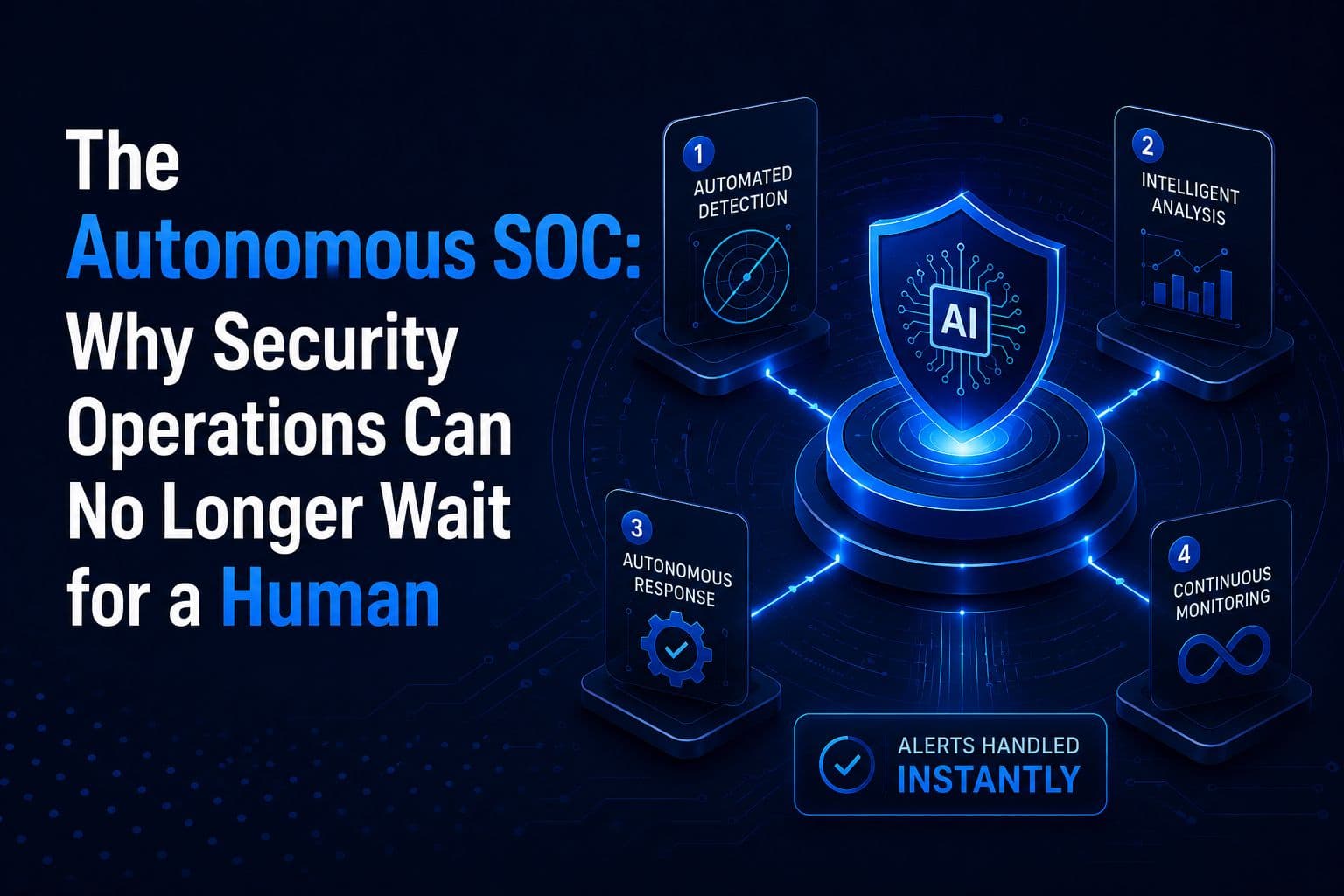
At Conux, five AI agents run that loop at the gateway every connection passes through. One detects. One blocks the traffic and writes the rule that keeps it blocked. One hardens the surface the attack probed. One logs the evidence in a form an auditor accepts. One orchestrates the other four.
Detect. Block. Adapt. Prove.
No queue. No analyst. No delay.
The distinction that matters is between alerting and acting. A traditional SOC produces a decision request: here is something suspicious, tell me what to do. An autonomous SOC produces a completed action plus a record of it: this was blocked, this is why, here is the evidence.
Where the humans go
The objection to autonomous response is always the same, and it is a fair one: what about false positives, and who is accountable?
Autonomy at the gateway does not mean nobody is in charge. It means the humans move from operating the loop to governing it. They set the policy the agents enforce. They review what was blocked and why. They tune thresholds, adjudicate edge cases, and own the outcomes.
That is a better use of a skilled analyst than reading the four-hundredth alert of a shift. The reason analyst burnout is endemic is not that the work is hard: it is that most of it is triage a machine should have done.
Why this cannot be a separate product
Here is the trap that catches most enterprises building toward this.
You can buy an AI-driven detection tool today. You can buy a response automation tool today. You can bolt them together. And in 2027, when CNSA 2.0 requires post-quantum cryptography across your estate, you will discover that neither of them touches encryption, and you will replace or re-architect both.
Meanwhile the second attacker has been working the whole time. Nation-state actors are collecting encrypted enterprise traffic now, not to read today, but to decrypt once quantum matures. Harvest now. Decrypt later. Exploit forever.
An enterprise that solves autonomous response and quantum-safe encryption separately buys two products, runs two migrations, and carries two sets of integration risk.
Conux is a cybersecurity gateway that answers both. Every connection passes through it. At that point it stops autonomous attacks in seconds, applies quantum-safe encryption, governs machine identities, enforces policy, and generates audit evidence: from one deployment.
What it takes to get there
The reason enterprises defer this is that they assume it means rebuilding.
It does not. Conux sits in the middle of what you already run. Existing cloud. Existing identity provider. Existing applications. Existing AI models. Nothing gets ripped out, and the deployment is measured in weeks, not migration programmes. Users never see it.
That matters more than it sounds. The single biggest predictor of whether a security capability actually gets deployed is not how good it is: it is how much of the existing estate it demands you disturb.
What to measure once the loop closes
Traditional SOC metrics stop being meaningful in an autonomous model, and teams that keep reporting them end up describing a process that no longer exists.
Mean time to detect was always a proxy. It mattered because detection was the start of a long human process. When blocking happens in the same instant as detection, MTTD and MTTR collapse into one number, and the interesting question becomes different.
Alert volume was a workload metric: how much triage the team faced. In an autonomous model the machine absorbs that volume, so counting it measures the environment rather than the team.
Four measures replace them.
Time to block. Not time to notice, not time to escalate: the interval between first hostile connection and enforced refusal. This is the number that determines whether an attack completed. Track its distribution, not its average; the tail is where the damage is.
Autonomous action rate. What proportion of hostile events were resolved without a human touching them? A low rate means the policy is too narrow and the loop is still routing to people. A rate approaching total with no review process means governance has gone slack.
Policy precision. Of the connections blocked, how many should have been allowed? This replaces false-positive rate as the quality signal, and it points at a fixable thing (the policy) rather than at a tuning knob.
Evidence completeness. For any blocked event, can you produce the record an auditor accepts without assembling it from four systems? If enforcement and logging happen at the same point, this should be trivially true. If it is not, the evidence is being reconstructed, which means it is partial.
There is one operational discipline that matters more than any metric: reviewing what was blocked. Autonomous enforcement fails quietly when nobody reads the refusals. A weekly review of blocked traffic is how policy stays accurate and how the team keeps genuine visibility into what the environment is doing: the difference between automation you govern and automation you have stopped thinking about.