Every economy runs on a layer of trust most people never see. The AI economy is no different -- except this time, the trust has to be engineered.
The global economy already depends on invisible trust infrastructure. When you tap a card, a dozen systems vouch for each other in milliseconds. When you load a website, certificates silently confirm it is what it claims to be. You never see this machinery, but commerce stops without it.
The AI economy raises the stakes by an order of magnitude. When software agents negotiate, transact, and act on your behalf, the trust between them cannot be assumed or manually checked. It has to be built into the substrate -- engineered, cryptographic, and continuous. Digital trust stops being a compliance checkbox and becomes the infrastructure the whole economy stands on.
Trust Has Always Been Infrastructure
Markets do not run on goods and money alone. They run on the confidence that the other party is real, authorized, and accountable.
Banking, contracts, supply chains, payments -- every one is a trust system wearing a different costume. We built institutions, laws, and intermediaries to manufacture confidence between strangers. The digital era moved much of that machinery into cryptography and certificates, mostly out of sight.
The pattern holds: whoever owns the trust infrastructure of an era owns its most defensible position. Visa and Mastercard are, at their core, trust networks. The next one is being built for machines.
Why the AI Economy Breaks the Current Model
Digital trust today is built around humans and websites. The AI economy is built around autonomous agents -- and the old model was never designed for them.
Web certificates prove a server is genuine to a human's browser. But an AI agent acting for your business is neither a human nor a website. It is a new kind of economic actor with no native way to prove who it is, what it may do, or whether it has been compromised.
Multiply that by thousands of agents across an enterprise, then by every partner and supplier doing the same, and you have an economy of actors with no shared trust fabric. That gap is not a niche security problem. It is a structural one.
The Components of Engineered Trust
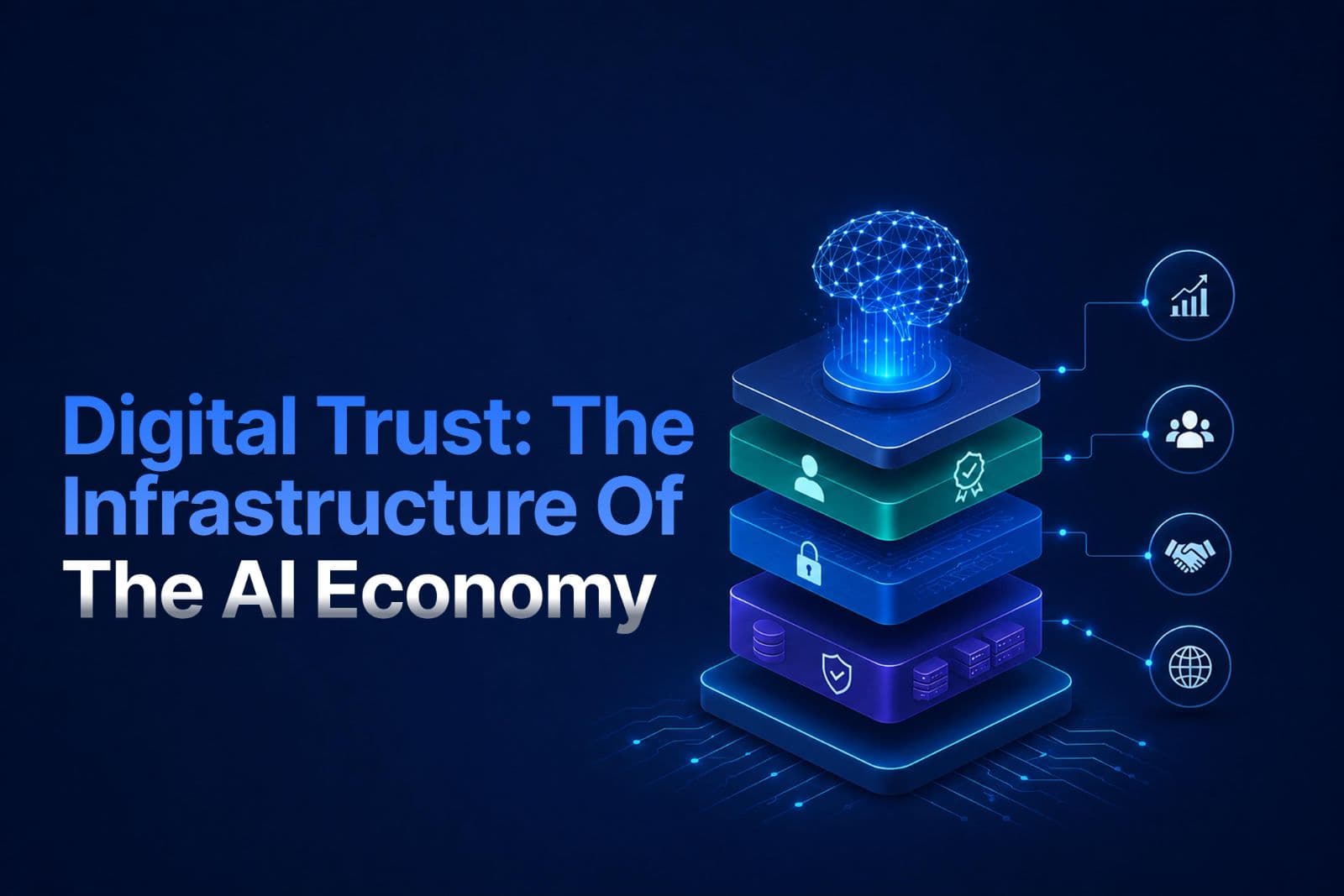
Engineered digital trust rests on three pillars: verifiable identity, provable authority, and tamper-evident integrity.
Identity answers who. Authority answers what they are permitted to do. Integrity answers whether they -- or their instructions -- have been altered. When all three are cryptographic and machine-readable, trust can be established automatically between parties that have never met.
This is the difference between trust as sentiment and trust as infrastructure. Sentiment doesn't scale to a billion autonomous interactions a day. Infrastructure does.
Trust as a Competitive Moat
In the AI economy, the organizations that can prove trust fastest will move fastest -- and the ones that cannot will stall.
Every enterprise wants to deploy autonomous agents. The constraint is rarely the model. It is the inability to safely let software act without supervision. The company that solves trust internally unlocks automation its competitors cannot risk.
That advantage compounds. Faster, safer autonomy means lower cost, quicker decisions, and the confidence to extend automation into higher-stakes processes. Trust infrastructure is not overhead. It is leverage.
Why It Has to Be Quantum-Resilient
Trust infrastructure built on today's cryptography has a known expiration date. Building it without quantum resilience is building on borrowed time.
The cryptography that makes digital trust possible -- the same keys and signatures that secure identity and integrity -- is what quantum computing is on track to break. Any trust layer that ignores this is engineering its own obsolescence.
Conux builds digital trust infrastructure that assumes the quantum transition rather than denying it. The foundation of the AI economy should outlast the threats already visible on the horizon.
Related Reading from the Conux Blog
- The Encryption Reckoning: Why Cryptographic Modernization Is the Decision of the Decade
- Why AI Needs a Trust Layer
Conux is engineering digital trust as foundational infrastructure for the AI economy. Learn how it applies to your enterprise.