What are post-quantum digital signatures?
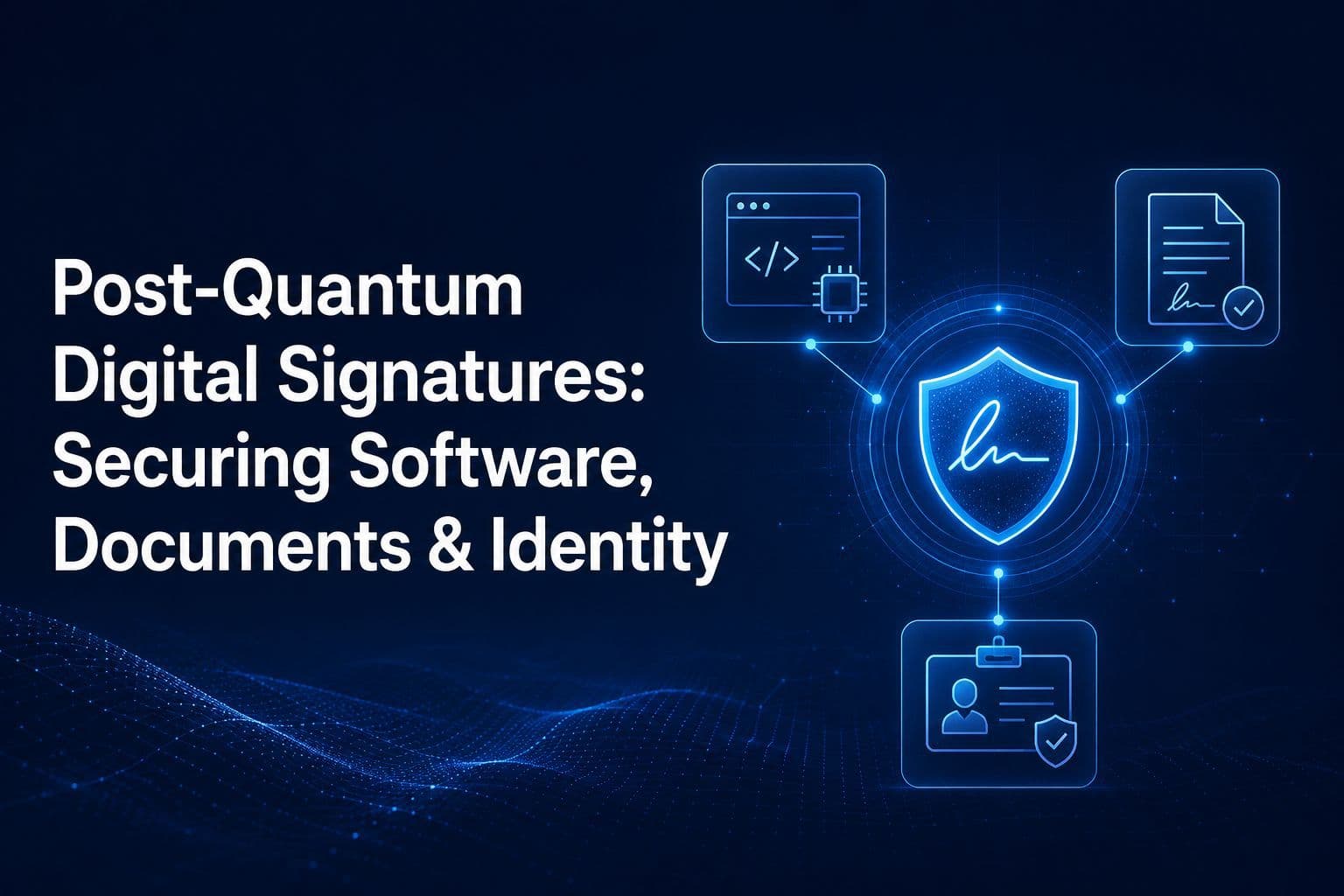
Post-quantum digital signatures are signature algorithms that remain secure against quantum computers, protecting the authenticity and integrity of software, documents, and identities. Where encryption keeps data secret, signatures prove that something is genuine and unaltered: that a software update really came from the vendor, that a certificate really belongs to the server, that a signed contract has not been tampered with. Quantum computers threaten today's RSA and ECDSA signatures just as they threaten encryption, and the consequences of forged signatures are every bit as severe.
NIST standardized two: ML-DSA (FIPS 204), a fast lattice-based scheme for general use, and SLH-DSA (FIPS 205), a conservative hash-based scheme for high-assurance cases.
Why do signatures matter as much as encryption?
Encryption protects confidentiality; signatures protect trust, and trust is what holds an enterprise's systems together. Consider how many everyday operations depend on a valid signature: every software and firmware update your systems accept, every TLS certificate that authenticates a server, every signed document, every code package pulled from a repository, every authenticated API call between services. Each one relies on a digital signature being unforgeable.
If a quantum computer can forge those signatures, an attacker could distribute malicious software that appears legitimately signed, impersonate trusted services and certificate authorities, or repudiate agreements that were genuinely signed. The damage is not limited to secrecy: it is a collapse of the ability to know what is real. This is why signatures deserve their own dedicated migration plan rather than being treated as an afterthought to encryption, and why quantum-safe signing is foundational to machine identity and the broader trust fabric enterprises run on.
How do ML-DSA and SLH-DSA differ?
ML-DSA and SLH-DSA differ across the same three dimensions. On speed, ML-DSA produces fast, compact signatures, while SLH-DSA produces slower, larger signatures. On assurance, ML-DSA rests on strong, newer math, while SLH-DSA is very conservative and well understood. On typical use, ML-DSA suits general-purpose signing, while SLH-DSA suits high-assurance, long-lived roots.
Most enterprises will use ML-DSA for everyday signing because it is efficient and compact. SLH-DSA is reserved for cases where maximum conservatism justifies the performance cost: long-lived firmware signing keys, root certificates, or anything that must remain trustworthy for decades. Keeping both available is itself a form of resilience: if lattice-based schemes were ever weakened, hash-based signatures provide a fallback rooted in different mathematics.
Where do post-quantum signatures apply first?
The highest-priority targets are signatures on long-lived assets, because their exposure stretches furthest into the future. Three stand out. Code-signing and firmware-signing keys protect software that may run for years: a signing key broken by a future quantum computer could retroactively undermine every device or update it ever signed, including devices still in the field. PKI roots and certificate authorities anchor trust for entire organizations; compromise there is catastrophic. And document or transaction signing with long legal validity must remain verifiable long after signing.
That long tail of exposure is why signature migration is urgent even though a quantum computer is not here yet. A firmware key you use today might still be validating updates in a decade, inside the plausible CRQC window. For device-heavy environments, this connects directly to post-quantum cryptography for IoT, where firmware signatures are the backbone of device trust.
What makes signature migration operationally hard?
Signatures are a two-sided problem: both the signer and every verifier must understand the new algorithm. Rolling out ML-DSA signing is only useful if the systems checking those signatures can validate them, which means coordinating updates across a wide surface of clients, devices, and services, some of which you may not fully control. Certificates add another dimension, because they have lifecycles, expiries, and chains of trust that all have to be migrated coherently.
This is why signature migration is as much a coordination and governance challenge as a cryptographic one. It touches identity systems, PKI, code pipelines, and device fleets simultaneously, and it cannot be done piecemeal without breaking trust chains.
How should enterprises migrate their signatures?
Start by finding every place signatures are issued and verified (code signing, PKI, identity systems, document workflows, service-to-service authentication) as part of your cryptographic inventory. Prioritize the keys protecting the longest-lived assets. Adopt ML-DSA for general signing, reserving SLH-DSA where conservatism is warranted. Plan explicitly for the signer-and-verifier coordination problem, using hybrid approaches where they help maintain compatibility. Treat it as a program with ownership and tracking, not a one-off swap, because the trust these signatures carry is exactly what an enterprise cannot afford to get wrong.