What's the difference between QKD and post-quantum cryptography?
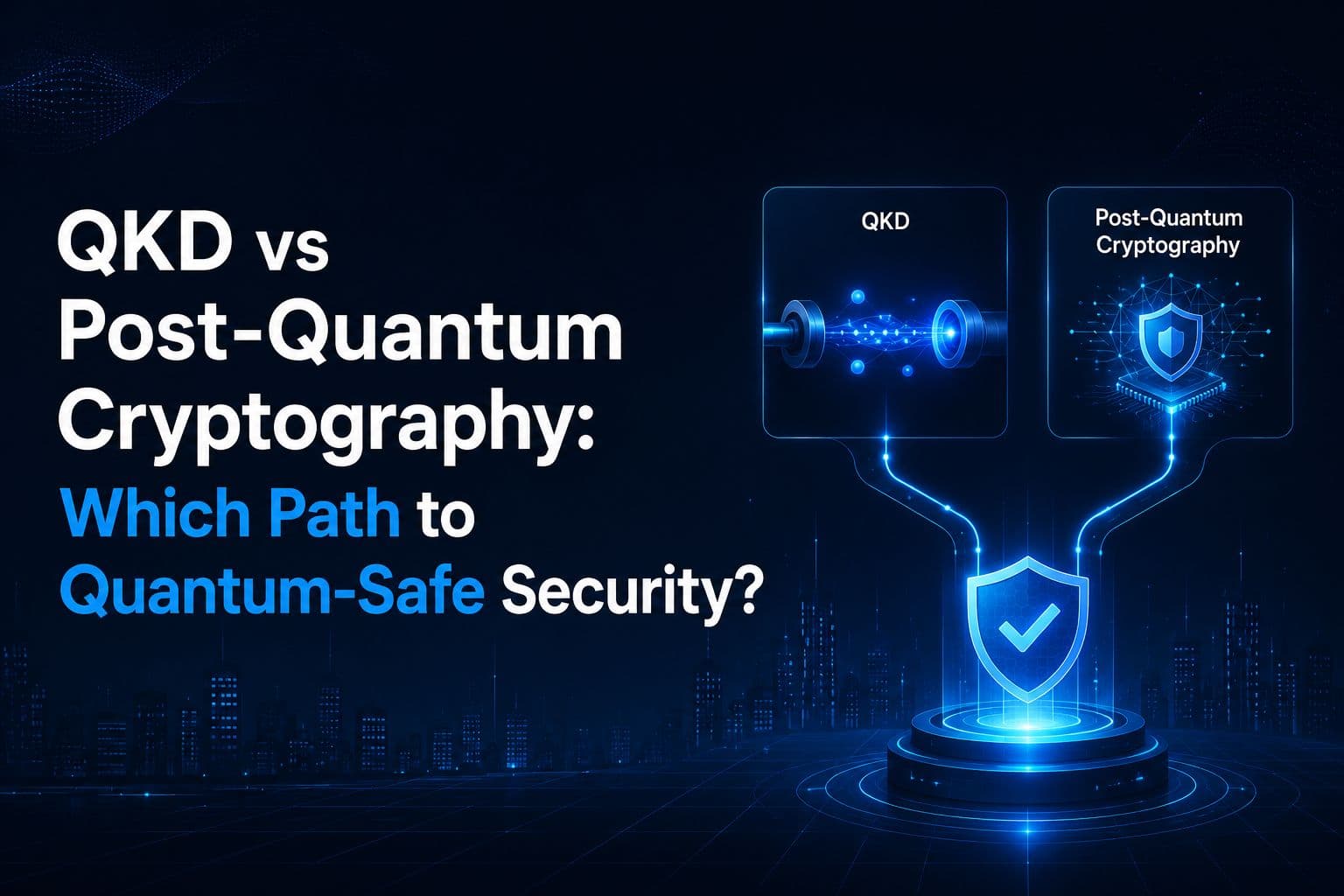
Quantum Key Distribution (QKD) and post-quantum cryptography (PQC) are two different answers to the same problem (protecting data from quantum computers), but they operate on opposite principles. QKD uses the laws of physics: it distributes keys over specialized hardware and optical links where any attempt to eavesdrop disturbs the quantum state and is detectable. PQC uses new mathematics: it runs as software algorithms on the computers and networks you already have.
For nearly every enterprise, that single distinction decides the answer. PQC is software you can deploy across existing infrastructure this year; QKD requires dedicated hardware, specialized fiber, and physical proximity. Both are legitimate science, but only one is a general-purpose enterprise tool.
How does QKD work, and where does it struggle?
QKD encodes key material onto individual photons. Because measuring a quantum state unavoidably changes it, an interceptor cannot copy the key in transit without leaving detectable evidence, a genuinely elegant security property rooted in physics rather than assumptions about computational difficulty.
But that elegance comes wrapped in hard constraints. QKD needs point-to-point optical links and specialized devices at each end. It has distance limitations, because photons degrade over fiber and cannot simply be amplified without destroying the quantum property. It does not scale to the mesh of connections a modern enterprise runs. And critically, QKD only distributes keys; it does not authenticate the parties, so it still needs conventional (or post-quantum) signatures to prove who is on each end. A secure key exchanged with an impostor is not secure at all.
How does PQC work, and why is it the practical default?
PQC replaces the vulnerable algorithms (RSA, Diffie-Hellman, ECC) with quantum-resistant ones such as ML-KEM and ML-DSA. Because it is software, it runs over the public internet, integrates with existing protocols like TLS, works between any two endpoints regardless of distance, and handles both key exchange and authentication. It requires no new hardware and no new fiber.
This is why NIST standardized PQC and why most national guidance points enterprises toward it as the primary path. The security rests on mathematical problems believed hard even for quantum computers, and unlike QKD, it can be deployed at the scale and topology real enterprises actually operate.
How do QKD and PQC compare for enterprises?
QKD and PQC differ across every practical dimension. QKD is grounded in physics, specifically quantum mechanics, while PQC is grounded in mathematics, specifically hard computational problems. QKD requires special hardware and dedicated fiber, whereas PQC runs as software on the systems an enterprise already has. QKD's reach is limited to point-to-point links, while PQC works globally over any network. QKD alone provides no authentication, since it only distributes keys, whereas PQC provides authentication as well as key exchange. QKD scales poorly to the mesh of connections a modern enterprise runs, while PQC scales well. And QKD is not standardized for general use, while PQC is standardized under NIST FIPS 203, 204, and 205.
The table makes the strategic picture clear. QKD has a role in specific, high-assurance, fixed-link scenarios: a dedicated connection between two data centres for an organization with extreme requirements and the budget for specialized infrastructure. It is not a general-purpose replacement for the cryptography running across your enterprise.
Which should your enterprise choose?
For the overwhelming majority of organizations, post-quantum cryptography is the practical choice: standardized, software-deployable, scalable, and covering authentication as well as key exchange. QKD is worth evaluating only for niche use cases with dedicated infrastructure and exceptional assurance requirements, and even then it is typically paired with PQC because QKD cannot authenticate on its own.
The strategic urgency reinforces the choice: PQC is deployable today, and the harvest-now-decrypt-later threat means data being captured right now is already at risk of future decryption. Waiting for QKD infrastructure to mature is not a viable defense for data that must stay confidential for years. The realistic enterprise answer is PQC as the foundation, with QKD considered only where a specific link and threat model genuinely justify the cost, and getting there starts with knowing what cryptography you run, via a cryptographic bill of materials.