
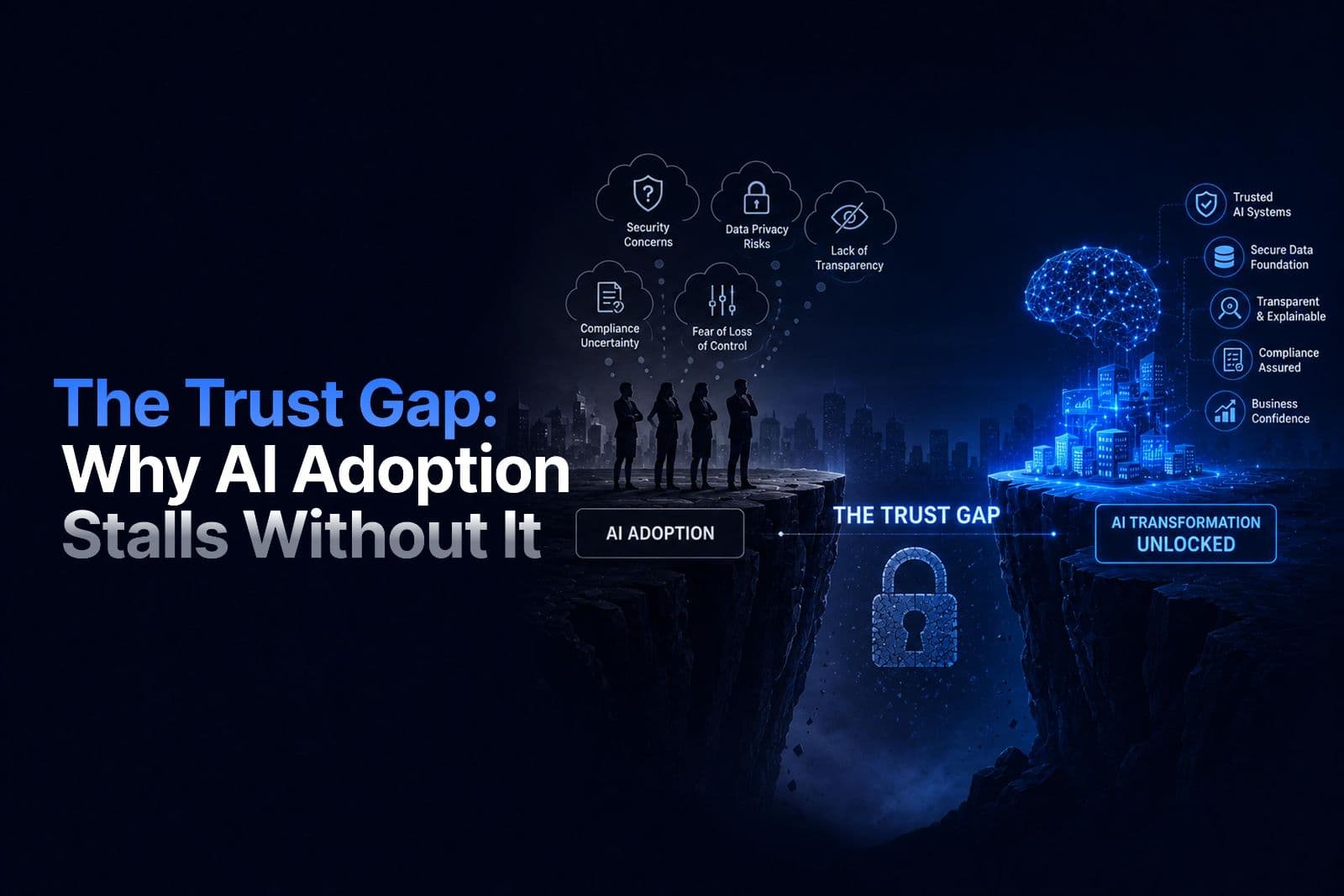
The biggest barrier to AI value in the enterprise is not cost, talent, or technology. It is a gap between what AI can do and what organizations dare to let it.
Walk into most enterprises and you will find AI pilots everywhere and AI in production almost nowhere that matters. Impressive demos stall on the way to real deployment. The reason is rarely that the technology failed. It is that nobody could answer the question that gates every serious rollout: can we trust this system to act on its own?
This is the trust gap, the distance between AI's capability and an organization's confidence to deploy it autonomously. It is where transformation initiatives quietly die, not in a crash but in indefinite caution. Closing it is the real unlock, and it requires infrastructure, not enthusiasm.
Where Pilots Go to Stall
The gap between a successful AI pilot and a production deployment is almost always a gap in trust, not capability.
Pilots run in safe, supervised conditions. Production means real money, real customers, and real consequences, often without a human watching each action. The moment an initiative crosses into that territory, the question stops being "does it work?" and becomes "can we trust it to act?"
Most organizations cannot answer that with evidence, so the initiative stalls in perpetual pilot. The capability was never the problem; the confidence to deploy it was.
Why Caution Is Rational
Leaders are not wrong to hesitate. Deploying autonomy you cannot verify is a real risk, and the instinct to keep a human in the loop is sound.
The hesitation reflects a genuine exposure: an unverifiable agent acting autonomously can cause harm that is hard to attribute and harder to stop. Keeping a human in every loop is a rational response to the absence of trust infrastructure.
But that response also caps the value. Human-in-the-loop autonomy is a contradiction that forfeits the economics of AI. The answer is not more courage; it is the infrastructure that makes courage unnecessary.
Closing the Gap Is an Infrastructure Problem
The trust gap closes not when leaders feel braver, but when the infrastructure can prove an agent's identity, authority, and integrity automatically.
Confidence to deploy comes from verifiability. When every agent has a strong identity, scoped authority, and tamper-evident integrity, all checkable in real time, autonomy becomes a controlled decision rather than a leap of faith.
That is a build, not a mindset. The enterprises that close the trust gap are the ones that put the trust layer in place, then deploy autonomy against it.
The Quantum Footnote That Isn't Optional
Trust infrastructure that closes the gap today must stay trustworthy through the quantum transition, or the gap reopens later.
An enterprise that closes the trust gap on quantum-vulnerable cryptography is borrowing confidence it will have to repay. When the cryptography weakens, the verifiability that enabled autonomy erodes, and the gap returns under worse conditions.
Conux closes the trust gap with quantum-resilient infrastructure, so the confidence to deploy autonomy holds rather than expires.
The Payoff of Closing It
Organizations that close the trust gap do not just deploy more AI. They operate at a tempo competitors stuck in pilot purgatory cannot match.
Closing the gap converts stalled pilots into production value and unlocks the high-stakes use cases where the real returns live. The advantage is not incremental; it is the difference between AI as experiment and AI as operating model.
Conux builds the trust layer that closes the gap, turning AI from something an enterprise is cautious about into something it can confidently run.
The trust gap is where AI value stalls. Conux builds the infrastructure that closes it. Let's discuss your deployment.