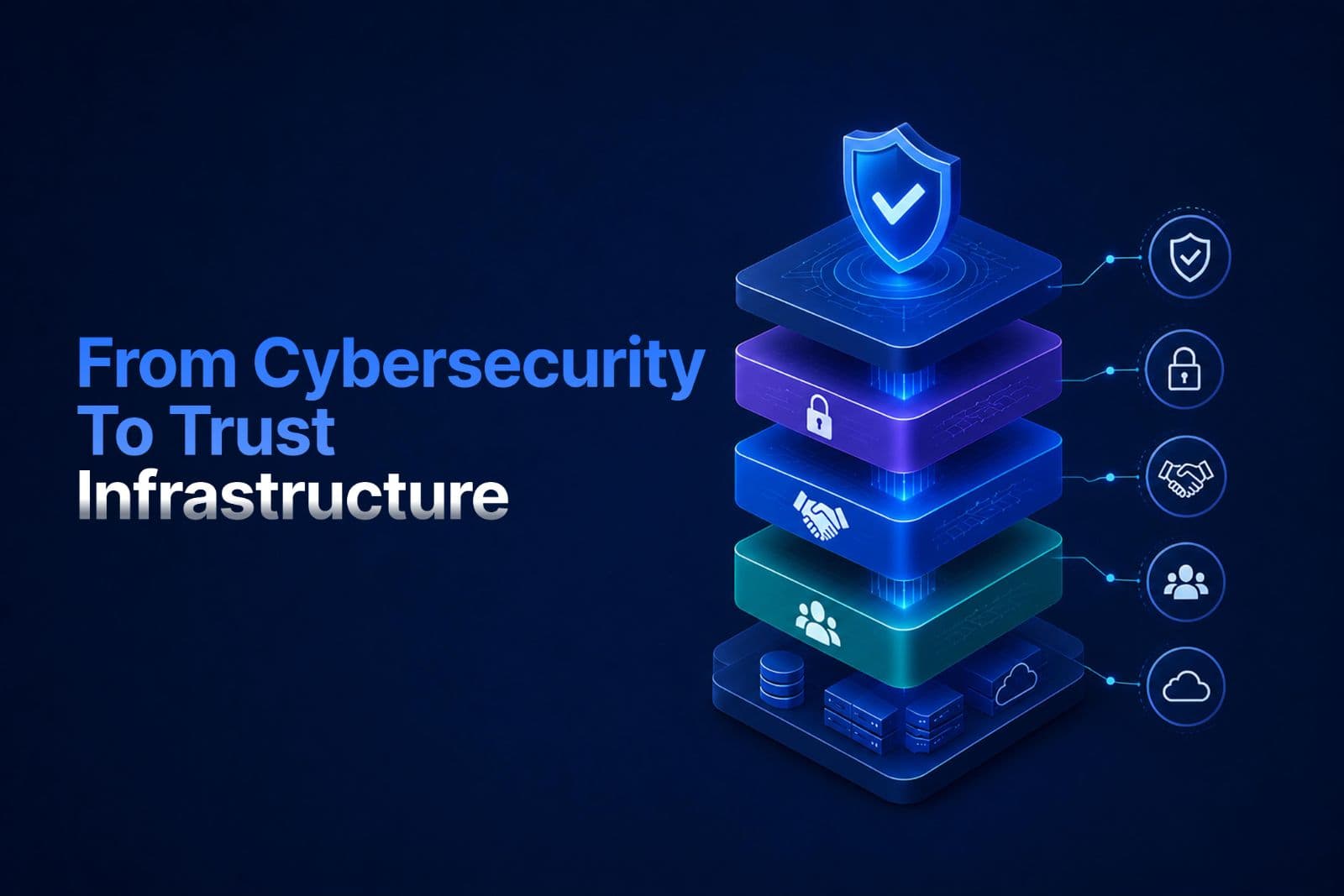
Cybersecurity was built to keep threats out. The AI economy needs something cybersecurity was never designed to do: let the right actors in, automatically, at scale.
For two decades, security has been framed as defense -- firewalls, detection, response. The mental model is a perimeter and an adversary. That model produced real value, and it is not going away. But it answers only half the question the AI economy is asking.
The other half is enablement. Autonomous business does not just need to keep bad actors out; it needs to verify and admit a flood of legitimate machine actors without a human gatekeeper. That is a different discipline. It is the shift from cybersecurity as a wall to trust as infrastructure -- and it is the arc Conux is built on.
The Limits of the Perimeter
A perimeter assumes a clear inside and outside. The AI economy dissolves that line -- its actors are everywhere, multiplying, and mostly machines.
Cloud, APIs, and now agents have eroded the perimeter to the point where "keep threats out" is necessary but nowhere near sufficient. When most actors are machines spread across systems you don't control, defense alone cannot tell you which of them to trust.
Security teams feel this daily: they are good at blocking what is clearly malicious, but the hard problem is verifying the vast middle -- the legitimate-looking machine actors that need to be admitted or denied in milliseconds.
Trust Is an Enabler, Not a Gate
Trust infrastructure does not just stop the wrong actors. It actively empowers the right ones to move faster than they safely could before.
When every actor can be verified automatically, you can grant autonomy you would otherwise have to withhold. The point of trust infrastructure is not caution; it is velocity with confidence -- letting software act because you can prove it should.
This reframes security from a cost center that says no into infrastructure that says yes, safely. That is the version of security the AI economy will pay for.
Why the Two Disciplines Converge
Keeping threats out and letting the right actors in are two sides of one capability: knowing, cryptographically, who and what to trust.
Detection asks "is this malicious?" Trust asks "is this verified?" In an agentic world, the second question increasingly answers the first. An actor that can prove its identity, authority, and integrity is one you can admit; one that cannot is one you can deny -- automatically.
Trust infrastructure does not replace cybersecurity. It absorbs and extends it, turning a defensive posture into a foundational layer that both protects and enables.
The Foundation Has to Be Quantum-Resilient
You cannot build durable trust infrastructure on cryptography with an expiration date.
Every trust decision -- every verified identity and validated signature -- rests on cryptography. The quantum transition will invalidate the primitives most security is built on today. Trust infrastructure that ignores this is laying a foundation it knows will fail.
Conux treats quantum resilience as a baseline property of trust infrastructure, not a future upgrade. The layer that admits the right actors must keep doing so after the cryptographic ground moves.
What This Means for Security Leaders
The mandate of the security function is expanding from defending the enterprise to enabling the autonomous enterprise.
Leaders who frame their role only as defense will find themselves the bottleneck on AI adoption. Those who build trust infrastructure become the reason the business can automate safely -- a far stronger strategic position.
Conux gives security leaders that posture: a trust layer that protects and enables in the same motion, built for the AI economy and the quantum era it must survive.
The shift from cybersecurity to trust infrastructure defines the next decade. Conux is building that layer -- start the conversation.