Most enterprises treat the quantum threat and AI risk as separate projects on separate roadmaps. They are the same problem wearing two faces.
Walk into a typical enterprise and you will find two distinct initiatives: a quantum-readiness effort run by cryptography and compliance teams, and an AI-governance effort run by data and innovation teams. They rarely talk. Yet the foundation underneath both is identical, and treating them separately is how organizations end up solving each one twice.
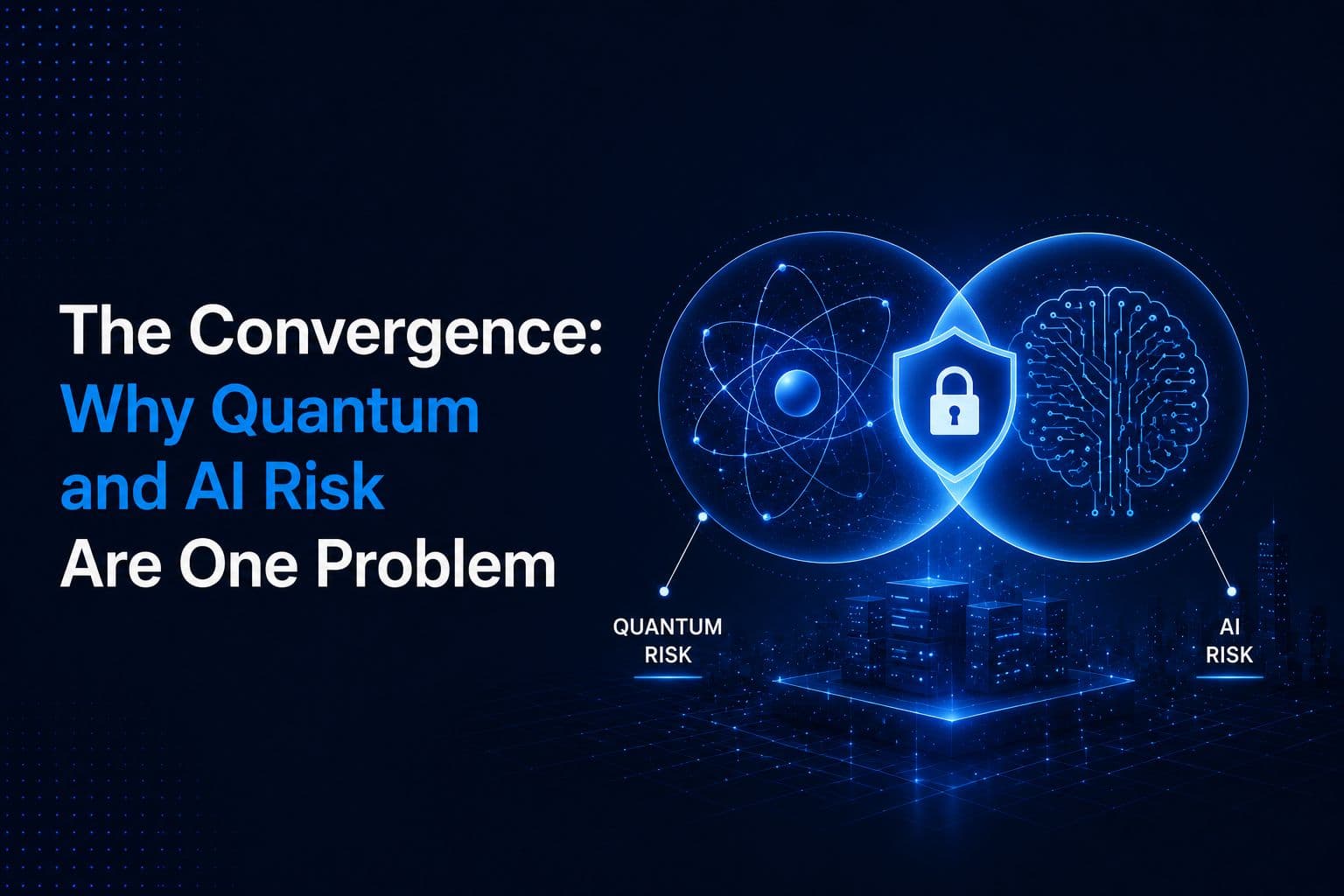
Both AI trust and quantum resilience come down to the same thing: cryptographic identity and integrity you can rely on. The agent you need to trust and the encryption you need to survive Q-Day are anchored in the same primitives. Convergence is not a buzzword here; it is the reason these two roadmaps should be one.
Two Roadmaps, One Foundation
AI trust and quantum resilience both reduce to a single requirement: cryptographic proof that holds. Solve it once, and you solve both.
AI governance asks whether you can trust a machine to act, which depends on verifiable, tamper-evident cryptographic identity. Quantum readiness asks whether your cryptography will survive, which determines whether that identity can be trusted at all. They meet at the same layer.
Run as separate programs, they duplicate effort and miss the dependency. Run as one, they reinforce each other: quantum-resilient cryptography is what makes AI trust durable, and AI is what makes quantum-resilient identity urgent.
The Cost of Solving Them Separately
An AI trust layer built on quantum-vulnerable cryptography is a project you will pay for twice.
Enterprises racing to establish machine identity for AI on classical cryptography are building a foundation with a known crack. When the quantum transition arrives, that foundation has to be torn up and rebuilt, re-issuing every identity, under pressure, on a deadline.
The separate-roadmap approach quietly guarantees rework. The convergent approach builds it right the first time.
Why AI Makes the Quantum Clock Faster
AI does not just coexist with the quantum threat. It accelerates the consequences of getting cryptography wrong.
More autonomous agents means more cryptographic identities, more machine-to-machine trust, and more that breaks if the underlying primitives fail. AI multiplies the surface area exposed to the quantum transition, raising the stakes of every cryptographic decision.
An organization scaling AI on weak cryptographic foundations is compounding its quantum exposure with every agent it deploys.
Harvest Now, Decrypt Later Meets Machine Identity
The data adversaries are harvesting today includes the cryptographic material that underpins tomorrow's machine identities.
The harvest-now-decrypt-later threat is usually framed around confidential data. But the same captured traffic can include the cryptographic context that secures identities and trust relationships, assets whose compromise reaches into the AI systems built on top of them.
Convergence makes the threat clearer: protecting data and protecting machine identity against the quantum future are the same defensive act.
One Program, One Foundation
The enterprises that treat quantum and AI risk as one problem will build one durable foundation instead of two fragile ones.
The strategic move is to unify the roadmaps: build a quantum-resilient trust layer that serves both AI governance and cryptographic modernization. One program, one foundation, no rework, and a security posture that is coherent rather than siloed.
Conux is built on this convergence, delivering the single foundation that makes AI trustworthy and cryptography durable at the same time.
Quantum and AI risk are one problem. Conux builds the single, quantum-resilient foundation that solves both. Talk to our team.